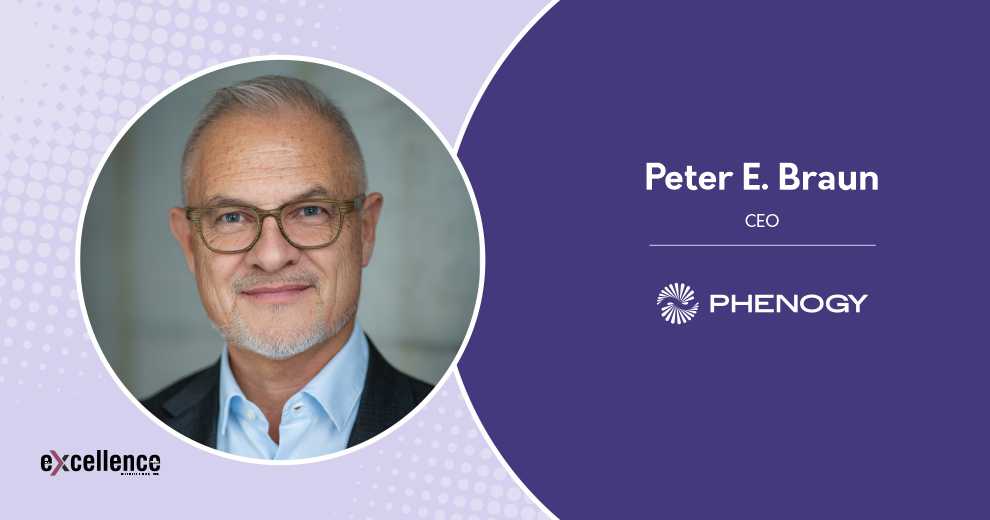
On a cold but bright September morning in 2025, cameras and microphones line up at the edge of an industrial site in Bremen. Journalists, TV crews and invited guests gather alongside local politicians and official representatives of the city to witness a technical premiere. On the Stage, PHENOGY CEO Peter E. Braun stands next to his CTO, Dr. Max Kory, facing a single white container that looks almost unspectacular from the outside.
With a single push of a button, Braun and Kory bring PHENOGY 1.0 online – Europe’s first large-scale battery energy storage system based on sodium-ion technology. The applause is polite but the step is significant: years of development, debate and doubt collapse into a few seconds of synchronised switching. For Braun, the day is not about showmanship. It is about proving that Europe can build cleaner, more resilient and locally anchored energy systems on its own terms.
It is a long way from aerospace labs to a white container in Bremen. For Braun, that distance is measured less in kilometres than in decisions: to leave a comfortable industry, to back an unproven chemistry and to build a company around the idea that resilience matters as much as performance.
From Aerospace Engineer to Systems Thinker
Peter trained as an aerospace engineer before making a deliberate move into renewable energy. Over more than two decades, he has worked across Europe, the Middle East, Asia and North America, leading companies through international IPOs, founding and selling a telematics business and investing in more than fifty startups. His time as a Board Member of the European Business Angel Network (EBAN) in Brussels, where he mentored founders focused on real-world impact, reinforced a belief that technology should answer to both humanity and the planet.
Purpose-Driven Leadership Beyond Comfort
“Innovation only counts when it creates lasting value for people, economies and the environment,” Braun says. That standard, he adds, is not a slogan but a filter – for which projects he backs, which compromises he refuses to make and which markets he is prepared to enter.
This conviction led him away from more comfortable roles in established industries and into the much less tidy world of energy systems. For Braun, building companies means taking responsibility for real-world problems and sticking with them long enough to make a measurable difference – even when that means going against the mainstream.
PHENOGY as an Expression of His Worldview
Under Braun’s leadership, PHENOGY AG develops sodium-ion battery energy storage systems for critical industrial, commercial and infrastructure applications. Its portfolio ranges from large-scale systems such as PHENOGY 1.0 to modular solutions like PHENOGY 1.1 and PHENOGY 2.1 – all based on inherently safer, thermally stable sodium-ion cell chemistry. With the European premiere and successful commissioning of PHENOGY 1.0 in Bremen, PHENOGY established Europe’s first large-scale sodium-ion battery energy storage system and positioned itself as a first mover in this field.
The systems support core use cases including peak-shaving to reduce load peaks and operating costs, intelligent self-consumption optimisation, microgrids and local grid support, backup and uninterruptible power supply for critical infrastructure, enhanced EV charging capacity and energy trading or arbitrage. By integrating inverters, cooling and intelligent energy management into compact units, PHENOGY simplifies planning, installation, remote operation and continuous safety monitoring for its customers.
Building Partner Ecosystems Instead of Selling Boxes
PHENOGY operates a partnership-driven B2B model that focuses on utilities, municipal agencies, infrastructure operators and industrial customers rather than end consumers. In the United States, PHENOGY Inc. in Columbia, South Carolina, serves as a hub for regional manufacturing and deployment, working closely with state authorities, universities, utilities and local partners. In Europe and other regions, PHENOGY AG in Switzerland and PHENOGY Europe GmbH in Germany coordinate long-term collaborations with public institutions and critical infrastructure operators. Across these markets, Braun aims to co-create resilient, decentralised energy ecosystems with customers instead of simply delivering equipment.
How Peter E. Braun Builds His Team
PHENOGY’s leadership team brings together more than 100 years of experience in research, development and entrepreneurship, supported by specialists in manufacturing, operations, product management, finance, IT, public relations and business development. The company works closely with institutes of the Fraunhofer Battery Alliance in Germany and the United States, integrating industrial research, testing and pilot production into its innovation pipeline.
Braun knows both sides of the corporate world. Early in his career, he worked in large industrial groups and quickly realised how much time could be lost in politics and how little direct contact there often was with customers and real problems. Many people who join PHENOGY share that experience. “A lot of our team came from big corporates where they weren’t allowed to be entrepreneurial,” he says. “Here, they are expected to take ownership.” That expectation comes with a clear message: entrepreneurship is not comfortable. Braun describes building companies as “a fight for survival from day one” – but also as the fastest way to learn what works and what does not. At PHENOGY, he looks for people who are willing to challenge assumptions, make decisions with imperfect information and stand by those decisions when conditions change. In return, they get the freedom to shape products, processes and partnerships instead of just executing predefined plans.
A Culture of Purpose and Execution
The culture is built around a shared purpose expressed in the vision “We energize the future. Sustainably.” and a firm belief in decentralised energy as a pillar of the green transformation. Under Braun’s leadership, teams are encouraged to think creatively while maintaining a strict focus on real-world readiness, from large-scale installations like Bremen to emerging opportunities with US partners. “Good ideas are worthless without disciplined execution and a strong team,” he says. This blend of freedom and accountability creates a strong sense of ownership and impact across the organisation.
As CEO and Co-Founder of PHENOGY, Braun is responsible for the strategic direction of the company, its international development and its positioning as a pioneer in sodium-ion energy storage. Key milestones under his leadership include the founding of PHENOGY in 2019 and the growth of a team of roughly sixty+ employees focused on future-oriented battery storage systems. The establishment of PHENOGY Europe GmbH in Germany and PHENOGY Inc. in Columbia, South Carolina as well as most recently PHENOGY PTE. Ltd. in Singapore, expanded the company’s regional presence and supports production and deployment in Europe, APAC and the Americas. Strategically, one of Braun’s key decisions was to focus on sodium-ion and other non-critical chemistries instead of joining the lithium race, laying the groundwork for more resilient, locally anchored value chains from raw materials to recycling.
Systemic Challenges in a Lithium-Dominated World
Braun faces a combination of technological, systemic and regulatory challenges. Building an independent supply chain for sodium-ion batteries in a market historically dominated by lithium-ion requires substantial effort, not least because many existing standards and regulations were written with lithium in mind. Securing certification and compliance for sodium-based systems under these frameworks demands persistence, extensive data sharing and continuous dialogue with regulators, policymakers and institutional partners.
He sees the biggest challenge as systemic: sodium-ion solutions are still often treated like lithium products, even though they differ in chemistry, safety profile and performance. PHENOGY therefore has to innovate on two fronts at once: advancing the technology and, in parallel, educating the market and working with regulators on better frameworks for sodium-ion storage.
Reading the Energy Rush in the US and Europe
For 2026 and 2027, Braun’s priorities are closely tied to PHENOGY’s expansion in the United States, where PHENOGY Inc. in Columbia, South Carolina, serves as a hub for regional manufacturing, deployment and partnerships. From there, the company aims to build localised supply chains and work with state authorities, universities, utilities and infrastructure partners to position sodium-ion storage as a backbone for regional energy projects and critical infrastructure.
In parallel, he plans to deepen PHENOGY’s footprint in Europe, building on projects such as the large-scale installation in Bremen, which demonstrates how sodium-ion systems can enhance resilience and reduce dependence on critical lithium supply chains. Braun sees the United States as a leading force in the global energy storage surge, driven by EV growth, AI-related power demand and the rapid build-out of renewables. At the same time, he believes that both the US and Europe will have to move beyond their current dependence on lithium, with sodium-ion and decentralised systems playing a central role in building more resilient, climate-neutral energy futures.
Resilience, Responsibility and the Role of Leadership
Behind the technical detail sits a simple idea: resilient, decentralised energy systems are, for Braun, a question of economic sovereignty and responsibility. In his view, energy and communication infrastructures have become prime targets in an era of hybrid threats, and robust, regionally anchored storage is a foundation for secure, future-proof economies. His conviction that innovation, prosperity and planetary stewardship can reinforce each other underpins his commitment to sodium-ion technology and to PHENOGY’s mission of energising the future sustainably.
Braun’s leadership style is often described as bold, collaborative and firmly rooted in reality. He combines scientific precision with human-centred innovation and insists that technological progress must remain tied to responsibility for people and the planet. “Entrepreneurship is not a lifestyle choice,” he says, “but a long-term commitment to solving real problems with resilient solutions.” Lasting progress, in his view, depends on collaboration – no single company can solve global energy challenges alone