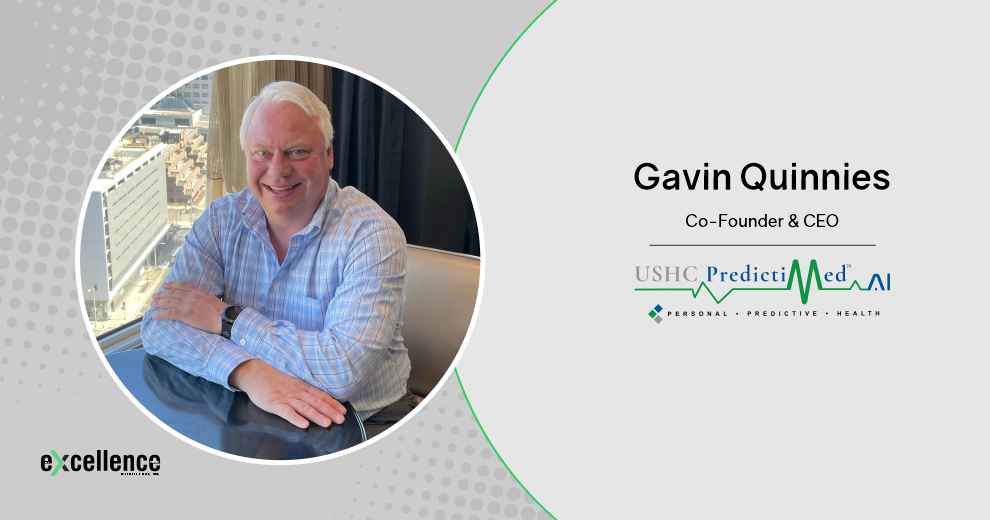
In a landscape crowded with bold proclamations about artificial intelligence (AI) transforming healthcare overnight, Gavin Quinnies has chosen a different path. Measured, deliberate, and deeply rooted in real-world application, Gavin has spent decades building the kind of predictive health infrastructure that most technologists only talk about. As Co-Founder and CEO of US HealthCenter, he stands among a rare breed of leaders who understand that the future of AI in healthcare is not found in a single breakthrough moment, but in the patient accumulation of insight, trust, and human connection.
From Aerospace to Predictive Health: A Journey Across Systems
Quinnies’ work in AI and healthcare has been shaped by a long journey across engineering, manufacturing, and population health. Long before AI became part of the mainstream healthcare conversation, his team was working with predictive systems in environments where safety, quality, and risk management were non-negotiable.
The foundation of this journey began in aerospace, where intelligent systems, automated planning, and early AI concepts were applied to complex manufacturing and operational challenges. Later, in industrial and manufacturing leadership roles, those same principles were applied to workforce safety, productivity, and health. It became clear that risk could be measured, predicted, and reduced not just in machines or processes, but in human systems as well.
In the early 1990s, the pioneer leader began experimenting with incentive-based wellness and onsite healthcare, learning firsthand that prevention, when thoughtfully designed, could improve quality of life while also reducing costs. Those experiences, combined with later consulting work in life sciences and healthcare automation, ultimately led to meeting Dr. Raymond Gavery, MD, a maverick and forerunner in the areas of functional medicine and direct primary care. Gavery had exited his functional medicine clinic business and together the two co-founded US HealthCenter. “Dr. Gavery’s love of research and tireless focus on improving the science behind what became PredictiMed(TM) was core to our success. His 40 years of experience gave us insight in clinical areas and together we concentrated on exploring new territory.”
From the beginning, the goal was not to build technology for its own sake, but to answer a practical question: Can we identify health risks earlier and help people act before problems become harder and more expensive to solve?
His personal mission now captures the spirit of everything that came before it: to help people and organizations use predictive insight to make better health decisions earlier, with clarity, empathy, and purpose.
Leadership Rooted in Application, Not Abstraction
For Quinnies, AI has always been about application rather than abstraction. AI is most valuable when it helps people understand risk, prioritize action, and navigate complexity with confidence. Over time, his vision evolved from building advanced analytics to building systems that people can actually use and trust.
One of the earliest lessoned learned from Dr. Gavery is that technology alone does not create change. Insight must be paired with engagement, guidance, and human support. That realization shaped the decision to expand beyond analytics into care navigation, advocacy, and coaching, creating an integrated approach rather than a collection of disconnected tools, hence the car navigation approach coined “Wholeistic™”.
The leadership values that guide his work are Consistency, Integrity, Patience, and Focus. In an industry that often chases trends, he believes in steady progress, evidence-based decisions, and long-term relationships.
Perhaps the most important lesson from leading innovation-driven teams is that strong alignment outperforms individual brilliance. His leadership philosophy is grounded in service: creating clarity around goals, removing obstacles, and trusting capable teams to do meaningful work.
Building Durable Impact in Predictive and Preventive Healthcare
Rather than pointing to a single achievement, Quinnies views impact as cumulative. Over time, his work has contributed to a broader shift toward predictive and preventive healthcare, helping employers, health plans, providers, and individuals think differently about risk.
By combining diverse health, lifestyle, and behavioral data into practical models, his teams have helped organizations anticipate future challenges instead of reacting to them after the fact. Just as importantly, they have learned how to translate those insights into engagement strategies that resonate with people on a personal level.
What distinguishes his work is not speed or scale alone, but durability. The focus has been on building systems, relationships, and cultures that hold up over time, even as technology and markets change.
Meeting Complexity with Integration and Simplicity
Healthcare presents unique challenges, particularly around fragmented data, misaligned incentives, and complexity that can overwhelm both organizations and individuals. Early on, Quinnies encountered skepticism, both about predictive health and about the idea that prevention could meaningfully change outcomes.
Rather than trying to solve everything at once, the pioneer leader focused on integration and simplicity. Bringing data, analytics, engagement, and care guidance together into a coherent experience required patience and iteration, but it also created clarity where confusion had previously existed.
Resilience, in his view, comes from purpose and perspective. Periods of rapid technological change are easier to navigate when decisions are grounded in fundamentals: evidence, ethics, and user experience.
Innovation Anchored in Ethics and Practical Integration
Looking ahead, Quinnies sees AI continuing its shift from retrospective analysis toward prediction and guidance. In healthcare, this evolution creates an opportunity to intervene earlier, personalize care more effectively, and align incentives around better outcomes rather than higher utilization. His current focus is on deepening integration, embedding predictive insight into everyday workflows for employers, providers, insurers, and individuals.
Ethical and responsible AI are foundational to this work. Trust, transparency, data security, and fairness must be built into systems from the start. AI should support human judgment, not replace it, and should always be used in service of improved well-being.
Growth Through Clarity, Reflection, and Continuous Improvement
Quinnies approaches growth with an emphasis on clarity, reflection, and continuous improvement. His focus remains on removing friction, simplifying systems, improving communication, and making work more meaningful.
He believes future AI leaders will need more than technical expertise. Systems thinking, ethical reasoning, communication, and patience will be essential skills. The ability to translate complex insight into practical action will define lasting impact.
Measuring Success in Lives, Not Lines of Code
For Quinnies, success in an AI-driven world is best measured by outcomes that endure: healthier lives, reduced risk, and systems that work more effectively because they were designed with people in mind. That yardstick is deliberately human-centered, and it reflects everything that has guided his journey from aerospace engineering to the forefront of predictive health.
Looking ahead, his focus remains on advancing predictive health, strengthening integration across healthcare ecosystems, and continuing to learn from the irreplaceable feedback loop of real-world application. In a field where the pressure to announce the next breakthrough is constant, Quinnies continues to make his most important contributions in a quieter register building the foundations that others will stand on long after the headlines have moved on.
A Message to the Next Generation of AI and Healthcare Leaders
For those entering AI, healthcare, or entrepreneurship, Quinnies acknowledges that progress often takes longer than expected and that meaningful change requires persistence. Surrounding oneself with people who share a sense of purpose makes that journey sustainable.
Technology, in his view, is a means, not an end. The most successful innovations solve real problems for real people, and do so in ways that are understandable, respectful, and humane.