In a year defined by bold ideas and transformative leadership, few figures stand out as profoundly as Nenad Gazikalovic, the Founder and Owner of Chartwell International School. His vision has not only shaped one of Belgrade’s most respected educational institutions but has extended into the creation of Green School by Chartwell, a pioneering model of holistic, nature-immersed learning. This is the story of a leader who believes that education must evolve with the world it serves, and whose work is leaving a meaningful mark on future generations.
Rooted in Vision
Mr. Gazikalovic’s journey as an education leader has always been driven by conviction rather than convention. When he founded Chartwell International School, the visionary leader set out to build more than a traditional academic institution. His ambition was to redefine what learning could look like for children growing up in an increasingly complex and interconnected world.
Over the years, Chartwell earned recognition for its strong academic foundation and international standards, but Mr. Gazikalovic’s vision stretched further. He observed how rapidly global priorities were shifting toward sustainability, emotional well-being, and real-world problem solving. The next evolution, therefore, had to be a school designed not only to challenge students intellectually, but also to nurture their humanity, resilience, and relationship with the natural world. Out of this belief, Green School by Chartwell was born.
A School That Lives and Breathes Learning
From the very beginning, Mr. Gazikalovic imagined Green School as a place where learning would be alive, purposeful, and deeply rooted in experience. Rather than confining students to conventional classrooms, he wanted them to move, explore, experiment, and build a relationship with knowledge that felt natural and intuitive.
The school’s approach is anchored in the Cambridge International Curriculum, a globally respected academic framework that provides rigor while allowing for flexibility. Under Mr. Gazikalovic’s leadership, this framework has been expanded through experiential, hands-on learning. Students don’t just study concepts; they observe them in nature, apply them in real life, and examine them through collaborative projects. This model supports the development of critical thinkers who understand not just the what, but the why and how behind every lesson.
The education leader’s philosophy is simple: when learning is meaningful and interconnected, it becomes transformative. And when children are engaged with both intellect and emotion, they develop the confidence to shape their futures with purpose.
Belgrade’s Hidden Oasis: A Campus Designed for Curiosity
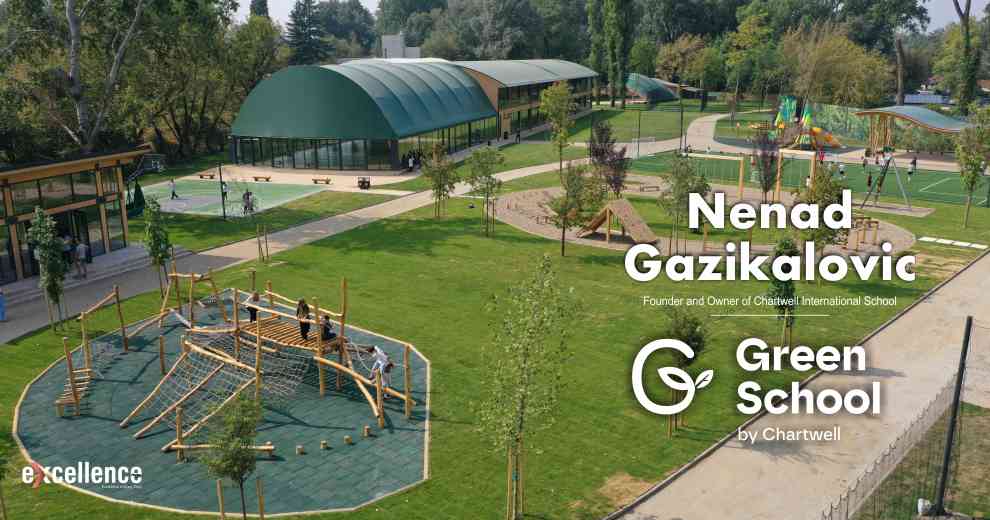
One of Mr. Gazikalovic’s defining decisions was selecting Ada Ciganlija as the home of Green School. Surrounded by lush greenery, water, and expansive open spaces, the location acts as a natural learning environment that encourages exploration and calm. He saw the potential of this sanctuary within the city and envisioned it as a place where children could think freely and feel inspired.
Every corner of the campus reflects intentional design. Outdoor classrooms sit shaded beneath trees. Gardens thrive with student-tended plants. An open-air theatre invites storytelling and performance. Spaces for movement, including a swimming pool and gymnastics studio, promote physical health and self-expression.
These elements were never added for aesthetics. They embody the visionary leader’s belief that environment shapes mindset. By providing space, beauty, and freedom, he ensures that students learn in a setting that mirrors the openness and curiosity he hopes to cultivate in them.
A Culture of Hands-On Exploration
Green School’s educational model goes far beyond textbooks. Under his direction, discovery becomes the primary engine of learning at Green School. Students spend their days questioning, experimenting, and observing rather than simply memorizing.
Science classes spill outdoors to analyze ecosystems. Math concepts are reinforced through real-life measurements and building activities. Community projects instill a sense of belonging and responsibility. Gardening teaches patience and cycles. Cooking introduces collaboration, creativity, and life skills.
This active approach to education nurtures adaptable, independent thinkers. Students learn how to analyze problems, work as a team, and apply knowledge to unfamiliar situations. According to the education leader, these are the attributes that will matter most in the rapidly evolving world they are stepping into.
Emotional Intelligence as a Core Component
Mr. Gazikalovic has long believed that academic success means little if children lack emotional intelligence, empathy, or self-awareness. For him, well-being is inseparable from learning. That is why Green School integrates mindfulness, movement, and creative expression into the daily rhythm.
Yoga, drama, outdoor sports, gardening, and cooking are not add-ons; they are essential parts of the curriculum. They help students understand themselves, regulate emotions, and develop healthy interpersonal relationships. The visionary leader’s commitment to holistic education ensures that children grow not just as learners, but as balanced and compassionate individuals.
Teachers as Mentors
Mr. Gazikalovic views teachers as guides, not just instructors. Under his leadership, educators at Green School form close, respectful relationships with students. They observe, listen, support, and encourage, helping children take ownership of their learning journey.
Teachers foster an environment where effort is valued as much as achievement. They celebrate curiosity and mistakes, both of which Nenad believes are essential for authentic growth. This mentorship-driven culture creates a community where students feel recognized, safe, and empowered to explore their potential.
Sustainability in Action
Commitment to environmental stewardship is one of the cornerstones of Green School. School wants students to grow up aware of their impact on the world and equipped with the mindset to protect it. Sustainability is not taught as theory; it is woven into daily life.
Students compost, recycle, conserve resources, and participate in eco-projects that demonstrate how small actions contribute to larger change. His goal is to build environmentally conscious individuals who understand the interconnectedness of human welfare and ecological balance.
Preparing Children for Life, Not Just Exams
Ultimately, Green School’s mission is to prepare students not merely for school, but for life.School aims to equip them with resilience, curiosity, creativity, and a strong moral compass. His hope is that they graduate with a sense of purpose and confidence, ready to contribute meaningfully to their communities and the world.
Green School by Chartwell represents the fulfillment of this mission. It is a living embodiment of Mr. Gazikalovic’s belief that education must be joyful, purposeful, and deeply human. Every day, he sees students collaborating, questioning, imagining, and growing. For him, these simple but profound moments affirm the importance of creating a school where learning feels alive.