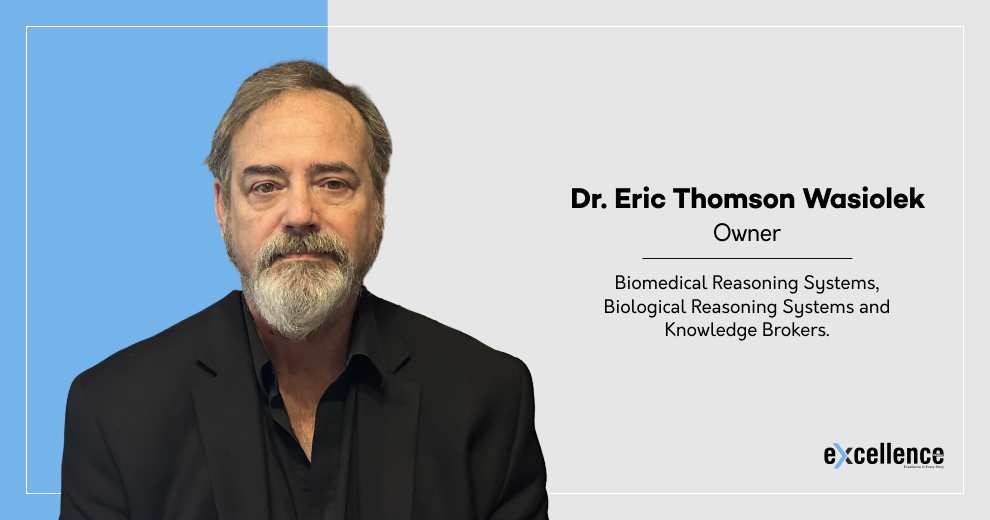
Dr. Eric Thomson Wasiolek stands at a rare intersection in modern science, where Artificial Intelligence (AI), computational biology, molecular science, philosophy, and technological innovation converge. His journey charts the evolution of scientific thinking across five decades, tracing a path from early neuroscience research to pioneering work in AI-powered biomedical reasoning models and the emerging frontier of synthetic biology. The innovator leader’s story is one of intellectual restlessness, curiosity, and the conviction that the future of human health will be shaped by the fusion of data, biology, and intelligent computational systems.
The Early Roots of a Scientific Thinker
Dr. Eric’s professional journey in biomedicine and synthetic biology began at Grinnell College in 1978–1979, where he undertook advanced coursework in neuroscience and physiological psychology and engaged in neuroscientific research. His interest in the life sciences resurfaced in 2002–2003 through involvement in stem cell advocacy and research with Stem Cell Action, leading him to pursue molecular biology and computer science as part of a master’s program in computational biology at Cal State East Bay from 2005–2008.
His academic path culminated in a master’s thesis in computational neuroscience at Stanford, where the visionary leader modeled the brain of C. elegans using graph data structures to analyze neural development and synaptic networks. With this foundation, Dr. Eric began attending Synthetic Biology conferences such as SynBioBeta, as well as AI and Generative AI events through IEEE, which sparked deeper exploration into the connection between these domains. Supported by a Doctorate in Computer Science earned in 2018 from Colorado Technical University, he viewed the intersection of AI and biotechnology as a natural extension of computational biology.
The innovator leader’s approach to scientific innovation is shaped by extensive experience in the computer industry, particularly in distributed computing, applications, and databases, combined with academic grounding in molecular biology, biotechnology, computational biology, and computer science, further complemented by degrees in philosophy and business administration, forming a multidisciplinary perspective aligned with emerging technological breakthroughs.
AI Transforming Biomedicine And Accelerating Research
From Dr. Eric’s perspective, AI is reshaping biomedicine across numerous domains, with growing influence on research acceleration and clinical applications. He notes that the technology is increasingly being integrated into processes that enhance efficiency, precision, and decision-making, and refers to additional elaboration connected to later insights on the subject. He has observed significant advancements driven by AI in multiple biomedical fields. In diagnostics, machine learning systems are now capable of identifying tumors and other medical conditions through object-recognition analysis of imaging data.
Drug discovery has seen remarkable progress as AI rapidly searches chemoinformatic libraries to pinpoint drug-like molecules, followed by determining optimal laboratory synthesis routes involving the fewest steps and readily available reagents. The visionary leader also highlights the expansion of personalized medicine through digital twin modelling, where an individual’s clinical history, DNA, and epigenetic profile, reflecting gene expression influenced by lifestyle, inform more tailored care. His involvement extends to two companies developing such approaches: GNQ, which employs a knowledge-graph-based AI reasoning system for diagnosis, and Koherent, which supplies the AI protocol for the agents operating within the application.
Dr. Eric also points to an ongoing project as a clear example of AI advancing biomedical progress. The initiative at GNQ, led by CTO Sudhir Saxena, in collaboration with Koherent under innovator Sean Koh, focuses on enhancing treatment recommendations and patient outcomes. The effort applies an AI Agent Reasoning System to a knowledge graph encoding digital twin patient data, where each node and edge represents drug interactions, epigenetic influences, and their effects on medical results.
Synthetic Biology Today and Its Direction
Dr. Eric describes synthetic biology as a young but fast-growing field with significant potential to improve human health. He highlights the mRNA vaccines from Moderna and Pfizer as a major example of what the field has already achieved. Looking ahead, the innovator leader believes progress will continue through the development of new drugs, genes, and proteins, and through engineered biological components such as artificial amino acids and modifications to the genetic code. According to him, these advancements may support better health outcomes and could even contribute to increased longevity.
Projects and Research Areas
Dr. Eric is engaged in several initiatives related to synthetic biology. He is working with Koherent and Rahul Vishwakarma on a model of intercellular signaling, and he will present Rahul’s paper on an AI Agent architecture for this work at the IEEE New Era AI World Leaders Summit in Seattle. The visionary leader is also collaborating with GNQ and Sudhir Saxena on a knowledge-graph-based clinical diagnostic system and may contribute to a biological reasoning model. In preparation for future ventures, he has secured potential business names, including Biomedical Reasoning Systems, Biological Reasoning Systems, and Knowledge Brokers.
Beyond active projects, Dr. Eric follows broader areas of emerging research. With experience in the computing industry, he is particularly interested in biological logic gates and circuits, noting that a biological adder has already been created. He continues to explore stem cell technologies for disease treatment and organ regeneration and is interested in machine-learning-supported docking tools for studying drug–protein interactions, drawing from earlier genomic research. Eric anticipates expanding his involvement in additional AI-driven synthetic biology initiatives.
Role of AI in Advancing Synthetic Biology
Dr. Eric explains that AI strengthens synthetic biology across multiple applications. Machine learning improves medical image interpretation, AI accelerates drug discovery through chemoinformatic analysis, and docking models allow drug–protein binding evaluation in silico. He notes emerging virtual cell models for simulated drug testing, AI tools for designing novel proteins, and systems that predict three-dimensional protein structures from amino acid sequences, such as AlphaFold. AI also contributes to the design of genetic circuits that control gene expression. He emphasizes that these examples represent only a fraction of AI’s growing impact on the field.
From Stem Cells to Smart Diagnostics
GNQ is focused on solving real-world healthcare challenges by improving diagnosis, treatment, and clinical outcomes through its AI-driven knowledge graph technology. Its intercellular signaling models support deeper understanding of disease development, including tumorigenesis. Koherent complements this work by securing medical records of digital twins using the PoR protocol in full compliance with HIPAA standards.
In its workflow, GNQ integrates extensive biological and biomedical datasets, drawing from sources such as GenBank for gene data, the Protein Data Bank for protein structures, and KEGG and Reactome for metabolomic network models. These datasets are incorporated into machine learning systems and knowledge graph frameworks to enhance research and discovery.
A pivotal moment in the researcher’s career arose from early involvement in stem cell initiatives, which led to pursuing computational biology. This reinforced the belief that such technologies could support treatments for disorders like juvenile diabetes and Parkinson’s disease, and potentially enable patient-specific organ growth without rejection. Advances in reprogramming adult stem cells into pluripotent cells helped address ethical concerns associated with embryonic stem cells, while institutions such as the California Institute for Regenerative Medicine continue to fund and advance this research.
Ethical Challenges at the Intersection of AI and Synthetic Biology
Dr. Eric emphasizes that combining AI with synthetic biology introduces significant ethical risks, particularly the potential creation of harmful or malicious entities. In synthetic biology, this could manifest through engineered viruses designed for biological warfare, while in AI, autonomous robotic or drone systems may be weaponized for conflict. He also notes that AI can amplify cybercrime through advanced digital attack tools. According to him, the core challenge is maintaining safety without suppressing innovation. He acknowledges that adversarial regimes may exploit these technologies beyond regulatory reach, making global cooperation essential, even though compliance cannot be guaranteed.
Regulatory Responsibility for Bio-AI Technologies
Dr. Eric maintains that policymakers and global health authorities must regulate rapidly advancing bio-AI technologies with caution. He stresses the need for safeguards that do not hinder scientific and technological progress, advocating for balanced oversight that encourages advancement while mitigating risk.
The innovator leader asserts that organizations must prevent the release or development of harmful applications and ensure that innovation remains directed toward human benefit. He highlights transparency as a particular concern in AI, where the internal processes of machine learning models often remain opaque due to hidden layers within latent space. Dr. Eric points to ongoing efforts to address this issue, noting that GNQ and Koherent’s PoR protocol are building mechanisms that reveal the reasoning steps behind AI outputs, helping establish accountability and trust in emerging technologies.
Fostering Innovation in Emerging Technologies
Dr. Eric emphasizes that both AI and synthetic biology are, by nature, innovation-driven fields. He highlights that synthetic biology involves creating entirely new biological entities, while generative AI systems produce original outputs when new data is introduced into trained models. Through this perspective, the visionary leader promotes a culture where exploration, originality, and scientific curiosity are core expectations rather than exceptions.
Furthermore, he maintains that innovation must align with real-world usefulness to achieve commercial viability. Dr. Eric notes that any organization working in AI or synthetic biology must deliver products that address tangible needs. He points to GNQ as an example, explaining that the company develops diagnostic systems designed to support doctors and medical laboratory assistants, demonstrating how scientific advancement can translate directly into clinical value. The innovator leader observes that the industry’s evolution has made data the foundation of progress, especially with machine learning–based AI. He explains that this shift is why many aspiring professionals now pursue data science degrees. In synthetic biology, Dr. Eric identifies biological datasets—such as gene sets, protein sets, chemoinformatic molecule libraries, and metabolomic profiles—as the starting point for innovation, underscoring how his work and involvement have evolved alongside the growing importance of data.
Future Directions in AI and Synthetic Biology
Dr. Eric highlights three major trends shaping the coming decade: virtual cell models that enable computational testing and reduce animal experimentation, the convergence of deductive and inductive AI to better model cognitive processes, and increasing automation in research through AI-driven robotics and advanced search tools.
Pathways for New Entrants and Desired Impact
Dr. Eric encourages emerging researchers and entrepreneurs to combine data science with molecular biology to succeed in AI-enabled biotechnology. The visionary leader envisions long-term outcomes that enhance human health and longevity, including disease eradication supported by gene editing and machine learning.
Motivation, Learning, and Guiding Philosophy
He remains driven by a lifelong pursuit of knowledge across science, technology, and philosophy. Dr. Eric stays current through online resources and conferences such as SynBioBeta and IEEE events, recognizing that integration between AI and synthetic biology still requires independent thinking. His guiding principle is that transformative innovation occurs at the intersection of disciplines, a pattern he sees continuing in AI-based synthetic biology.