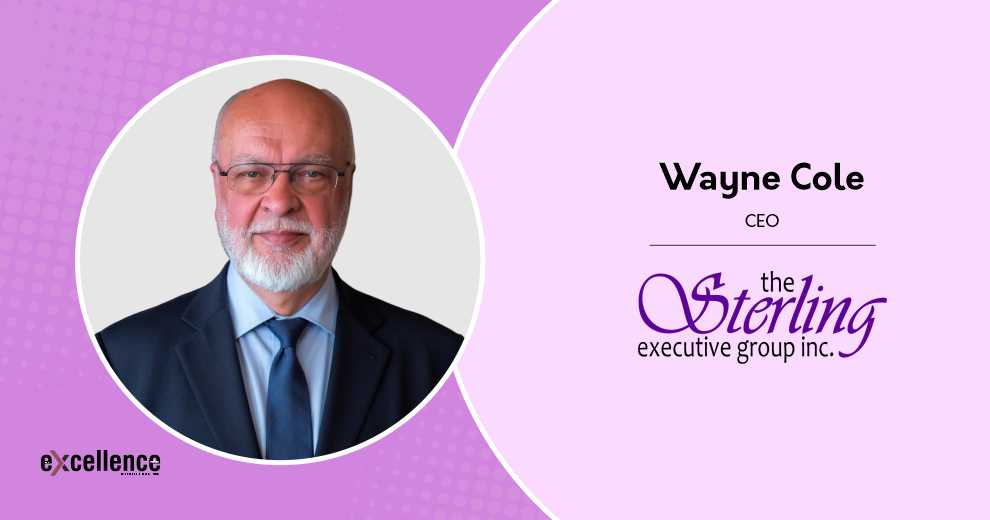
There is a question Wayne Cole (CEO of The Sterling Executive Group Inc.) has been asking CEOs for years, one that tends to land like a stone dropped into still water. Not loud. Not combative. But with a ripple that keeps moving long after the conversation is over. The question is deceptively simple: Is your leadership team actually ready to lead the business your strategy is trying to build?
For most leaders, the honest answer is uncomfortable. They have invested in courses, brought in coaches, sent executives to workshops, and approved one assessment after another. And yet, when Cole sits across the table from a CEO who is frustrated that growth feels harder than it should, he sees the same pattern playing out. The strategy is not the problem. The leadership system underneath it is underdeveloped. The team has been trained. It has not been built.
Cole founded The Sterling Executive Group Inc. to solve precisely this problem. As a CEO himself, he leads an organization whose entire purpose is helping other CEOs close the gap between the leadership team they have and the one their growth plan demands.
His flagship tool, the Leadership Field Manual, gives leadership teams a shared language and a common standard to work from. His Sterling peer groups give CEOs a confidential space outside their own organizations to think more clearly, challenge their own assumptions, and return to their businesses with sharper judgment. Together, they form what Cole describes as a practical bridge between leadership development and business growth.
What sets Cole apart is not that he has a framework. Many consultants have frameworks. What sets him apart is the discipline the transformational leader brings to a field that has long been content with good intentions and vague outcomes. In Cole’s world, leadership is not a soft topic reserved for off-sites and personality tests. It is a growth discipline, as rigorous and as business-critical as financial planning or market strategy.
Growth Demands More Than Ambition
Cole’s diagnosis of why leadership development so often fails to move the needle begins with a structural observation. As a business grows, the demands placed on its leadership team change in kind, not just in scale. A larger business needs more decision capacity. A more complex business needs better communication. A faster business needs stronger trust. A more ambitious business needs leaders who can delegate well, develop deeper talent around them, and function as one unified enterprise team rather than a collection of capable individuals protecting their own corners.
When leadership does not keep pace with that growth, the symptoms are unmistakable. Decisions slow to a crawl. Silos harden into walls. Managers stop using judgment and wait for direction. Good people become frustrated by unclear priorities. And the CEO, rather than leading the business forward, becomes the organization’s default problem-solver, the person every hard question eventually climbs back to. It is exhausting, and it is entirely preventable.
The transformational leader’s pivotal insight is that the question most organizations ask, how do we make our leaders better, is the wrong starting point. The better question, the one that actually unlocks change, is: what kind of leadership team does this business need next? That shift, from individual improvement to collective readiness, is what Cole calls the missing link. It transforms leadership development from a training calendar into a genuine growth discipline.
Every Leader Carries a Different Map
Part of what makes Cole’s work so resonant with CEOs is his unflinching honesty about human nature inside leadership teams. No team, he points out, starts from a clean sheet of paper. Every leader around the table learned leadership somewhere else, in a different culture, under a different mentor, through a different function, or simply by surviving their own mistakes. Each carries a personal model of what good leadership looks like, and that model is rarely made explicit.
For one leader, good leadership means being decisive and firm. For another, it means giving people freedom. For another, it means loyalty, or speed, or careful deliberation, or the kind of calm that holds a room together under pressure. These models shape everything: how a leader communicates, how they handle conflict, how they react when results disappoint, and crucially, how they protect themselves when things go wrong. Most leaders want to be seen as effective. Most will, consciously or not, protect their department, their budget, their team, and their reputation.
The result, when no shared standard exists, is an organization with many leadership styles but no leadership standard. And the transformational leader is precise about why that distinction matters. A leadership team can tolerate different styles, Cole argues. Different people bring different strengths, different approaches, different energies, and that diversity can be an asset.
What a leadership team cannot tolerate is different standards, different levels of accountability, different thresholds for honesty, different commitments to the enterprise over the individual. That inconsistency does not stay at the leadership level. It cascades. Employees feel it. One department gets coached; another gets ordered. One leader shares context openly; another hoards information. Over time, the organization fractures along the lines of its leadership gaps.
Setting the Standard Before Sending People to School
Cole’s solution begins not with a training intervention but with a conversation, one the leadership team has rarely been asked to have. Before any external development, before any courses or coaches are engaged, the team must answer a single demanding question together: What kind of leadership does our business need from us now?
This is where the Leadership Field Manual enters. Built around 18 foundational leadership principles, the Manual is not a reading list or a self-help guide. Its power lies in what it makes possible: a shared language across a leadership team that has never had one. Instead of each leader privately defining good leadership through their own lens, the team works from a common set of principles. They can discuss, honestly and specifically, what each principle means for their business, where their collective strength lies, where the gaps are, and what standard the business now genuinely requires.
Cole is equally clear about the limits of top-down mandates. A leadership standard announced only by the CEO remains an instruction. A leadership standard that the team defines, debates, and commits to together becomes something far more durable. It becomes practice. That distinction, between instruction and practice, is at the heart of everything the transformational leader does. His framework also introduces a nuance that most leadership development programs overlook: not every principle needs to operate at the same level at the same time.
He distinguishes between good practice, the disciplined competence that represents the minimum standard the organization can accept; best practice, the higher level of skill and consistency required when the business is growing, competing harder, or executing under pressure; and future practice, the leadership capacity being built now for the demands that are coming. A scaling business may need best practice in communication, delegation, and accountability immediately. A business preparing for transformation may need to begin building future practice in strategic thinking and adaptability before the need becomes urgent.
The point, Cole insists, is focus. Leadership development that tries to improve everything at once improves nothing with any depth. The work is to identify which principles matter most to the next stage of the business and go there with full commitment.
Closing the Gap With Discipline, Not Hope
Once a team has agreed on the standard it is aiming for, something important happens. The gaps become visible in a way they never were before. Without a common target, disagreements about leadership quality tend to become emotional and circular. Someone says communication is strong; someone else says it is not. Someone says accountability is working; someone else points to issues that keep getting quietly set aside. These debates go nowhere because there is nothing objective to measure against.
A defined standard changes the nature of the conversation entirely. The team can ask, with clarity and without defensiveness: Where are we now? Where do we need to be? Is this a gap in individual capability or in how we work together as a team? Which gaps are creating the greatest risk to the business right now? That last question matters enormously. Cole is direct that not all gaps carry the same weight. The leadership development work should follow the risk, not the preference.
He is equally clear that the remedy depends on the diagnosis. Some gaps live in individual leaders. A leader may need to strengthen their coaching, sharpen their financial judgment, become more deliberate in how they delegate, or learn to give hard feedback without deflecting. In those cases, the right investment is targeted: coaching, mentoring, a specific course, peer learning. Other gaps, and the transformational leader finds these are more common and more consequential, live in the team itself. The team avoids honest debate. It makes decisions too slowly. It tolerates silo behaviour that everyone can see and no one names. It supports decisions in the room and quietly undermines them in the corridor. These problems cannot be fixed by developing any individual leader. The team must change how it works together, and that requires a different kind of investment entirely.
Leadership Readiness Is Not a One-Time Event
One of Cole’s most practical contributions to the field is his insistence that leadership-standard work needs its own dedicated rhythm. Too many organizations treat it as an appendix to strategic planning or an agenda item at the annual retreat. Cole argues that it deserves its own quarterly meeting, separate from operational reviews, budget sessions, and strategy debates, focused on one question alone: Does our current leadership practice still match the needs of our business?
The questions that drive these quarterly sessions are deceptively simple and consistently revealing. Which leadership principles are most important for the next stage we are entering? Are we operating at the level the business now requires? Where have we improved since last quarter? Where are old habits returning? Which gaps are now creating business risk? What specific commitments will we make as individuals and as a team before we meet again? These are not feel-good questions. They are performance questions, and Cole treats them with exactly that seriousness.
His rationale is grounded in reality. Organizations change. Markets shift. The leadership team itself changes as people grow, as roles evolve, as new members join the table. A standard that was entirely adequate for the business twelve months ago may be genuinely insufficient for where the organization is heading now. The goal is never to define the standard once and file it away. The goal is a living alignment between the demands the business places on its leaders and the capacity those leaders actually possess.
The Loneliest Role in the Building
For all the rigour Cole brings to team-level work, he has never lost sight of something more personal: the particular weight of the CEO’s position. The CEO is expected to lead every conversation, absorb every hard call, protect the business, develop the team, and hold people accountable, often simultaneously, and almost always without a confidential sounding board inside the organization. Staff soften the message. Colleagues carry their own agendas. Even well-intentioned leadership teams can become trapped inside their collective assumptions. The CEO, by definition, has no peer inside the company.
This is the need that Sterling’s peer groups are designed to meet. The transformational leader describes them not as networking groups or CEO forums in the traditional sense, but as a confidential setting where experienced leaders help each other think more clearly and lead more effectively. Peers who understand the weight of the role but have no stake in the company’s internal politics can ask the direct questions that colleagues might avoid, challenge thinking that has gone unchallenged for too long, surface blind spots the CEO cannot see from inside, and share, with unvarnished honesty, what has worked and what has not in their own organizations.
What distinguishes Sterling from other peer group models, in Cole’s view, is structure. Many peer groups give CEOs a place to talk. That has value. But conversation alone does not build a leadership team. The Sterling model pairs the candour and challenge of peer dialogue with the practical tools of the Leadership Field Manual, giving CEOs something they can carry back into their own organizations and act on. The peer group sharpens the thinking. The Field Manual provides the mechanism for translating that thinking into changed behaviour at the leadership team level.
Cole’s aspiration for every CEO who works within the Sterling model is ultimately straightforward: to lead with greater clarity, to build a team that does not depend on the CEO carrying everything, and to grow a business without outrunning the leadership capacity required to sustain that growth.
Building the Team Before the Business Needs It
Wayne Cole does not promise shortcuts. He promises something more durable: a method for ensuring that the leadership team an organization has is the one its strategy actually requires, and that the gap between the two is closed with intention rather than discovered too late, when a growth plan stalls and no one can quite explain why.
His call to CEOs is both practical and hopeful. Agree on the principles that define your standard. Define that standard as a team, not as an edict. Find the gaps with honesty and without defensiveness. Match leadership readiness to growth, not as an afterthought but as a core discipline. Invest where the need is real. Build the team, together, before the business needs that team to carry a heavier load than it was ever prepared for.
It is, in the end, a deeply human vision. Great organizations are not built on strategy alone. They are built on the quality of the people leading them, and on the collective discipline those people bring to the work of becoming something more than the sum of their individual strengths. Cole has made it his life’s work to help CEOs build exactly that.