
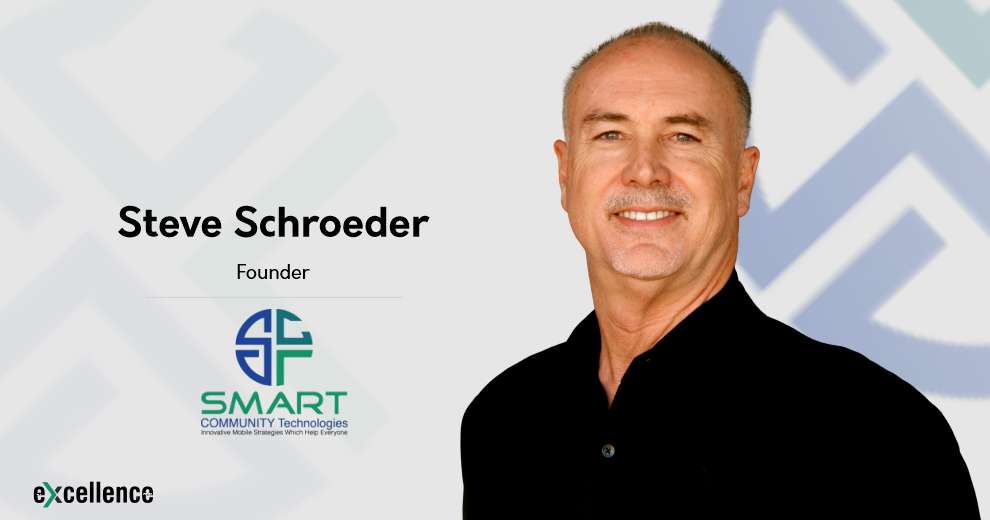
In a world where technology is evolving faster than institutions can adapt, some entrepreneurs focus on responding to change, while others work to recognize where that change is heading before it becomes obvious. Steve Schroeder belongs to the latter group. As the Founder of Grey Swan Capital and the driving force behind an expanding ecosystem spanning technology, real estate, fundraising, artificial intelligence, and decentralized solutions, Schroeder is building around a simple yet powerful belief: the greatest opportunities often emerge before the wider market fully understands them.
His philosophy is captured in the concept of the “Grey Swan”—a major event or structural shift whose direction is increasingly visible, even though its exact timing remains uncertain. Infrastructure investment, artificial intelligence, rising energy demand, data centers, evolving financial systems, and local economic development can all provide signals about where markets are heading. Schroeder’s approach is to identify those signals early, understand how they connect, and position people and capital accordingly.
The “Grey Swan” Way of Seeing the Future
The name Grey Swan Capital represents far more than an investment strategy; it reflects a distinctive way of looking at the world. While a Black Swan is generally associated with an event that is extremely difficult to anticipate, a Grey Swan leaves evidence behind. The signals may already be visible through policy decisions, construction activity, technology adoption, demographic shifts, infrastructure spending, energy requirements, or economic development. The challenge is recognizing what those signals mean before their consequences become obvious to everyone else.
That distinction sits at the center of Schroeder’s worldview. He looks for developments that are no longer purely hypothetical but have not yet been fully reflected in public expectations or market values. Artificial intelligence is perhaps the clearest example. AI may initially appear to be a software revolution, but its continued growth requires enormous computing capacity. That demand, in turn, requires data centers, electricity, land, water, transportation, construction, skilled workers, and supporting communities. What begins as a technology story quickly becomes an energy story, a real-estate story, an infrastructure story, a workforce story, and ultimately a capital-allocation story.
This interconnected way of thinking is what makes the Grey Swan philosophy distinctive. Schroeder’s initial strategy focuses on Arkansas, particularly the Conway and Clarksville corridors, where data-center and infrastructure developments could influence employment, housing demand, economic activity, and property values. The philosophy is straightforward: do not wait for tomorrow’s headline to confirm what today’s evidence is already suggesting.
From Data to Intelligence
One of Schroeder’s most ambitious expressions of this philosophy is Grey Swan Real Estate, a platform designed to move beyond the traditional property-listing model. Rather than simply displaying properties for sale, the vision is to create an AI-powered operating system that connects property discovery and intelligence with capital, financing, professional networks, tax resources, and other elements involved in real-estate transactions.
At the center of the concept is intelligence. The platform is being designed to examine information such as public records, tax data, comparable properties, distressed-asset indicators, liens, vacancies, pre-foreclosure signals, owner behavior, buyer and seller propensity, and local economic catalysts. The ambition is to move investors beyond simply knowing what exists toward understanding what matters.
That distinction is significant. A database provides information, but intelligence provides context. Context can reveal patterns, and patterns can help people recognize opportunities before those opportunities become obvious to the wider market. The Grey Swan model is therefore not built around the promise of predicting the future with certainty. Instead, it is designed around recognizing the signals that may already be pointing toward it.
“Technology Should Not Simply Make Existing Systems Faster. It Should Make Better Systems Possible.”
This principle sits at the heart of Schroeder’s approach to innovation. His philosophy is not based on the assumption that every useful solution must be invented from scratch. Instead, he approaches technology as a combination of existing tools, ideas, and infrastructure that can be brought together to solve problems in new ways.
He has described this mindset through the idea of being a “Master Chef of Technologies.” AI already exists. Bitcoin already exists. NOSTR already exists. eCash already exists. Real-estate data already exists. The entrepreneurial opportunity lies in understanding how these different technologies can work together to create something more useful than any one of them could provide independently.
That approach helps explain why Schroeder’s ventures extend across multiple industries. His work has included technology for community trust and loyalty, fundraising systems, decentralized communication, Bitcoin and eCash infrastructure, artificial intelligence, investment intelligence, and real estate. While the individual products may operate in different markets, they are connected by a common objective: giving people better information, greater participation, and more control.
The Grey Swan ecosystem reflects that broader ambition by bringing technology, capital, real assets, education, and community participation into a connected model. Different technologies. Different markets. One mission: build better systems that expand human agency.
Ownership Is More Than Possession
For Schroeder, technology ultimately raises a fundamental question: who controls the system? Who controls the data? Who controls identity? Who controls communication? Who controls financial tools? And perhaps most importantly, who has the freedom to choose something different?
His interest in Bitcoin, Lightning, eCash, and NOSTR is closely connected to these questions. Rather than viewing decentralized technology simply as a collection of emerging digital tools, Schroeder sees it as potential infrastructure for greater control over communication, identity, and value transfer. The Grey Swan Capital strategy incorporates these technologies as part of a broader effort to give users greater independence and flexibility.
This philosophy also extends into his approach to financial services. Grey Swan Capital is developing membership-based access to research, education, real-estate intelligence, tax resources, consultations, and other capabilities rather than relying exclusively on traditional investment-management structures. The broader objective is to make sophisticated information more accessible while encouraging people to become better informed about their own financial decisions.
The underlying philosophy is more important than any particular pricing model. Instead of keeping expertise behind an institutional wall, Schroeder wants to push more intelligence outward. The goal is not simply to manage someone’s money; it is to help people understand the forces influencing their money, property, businesses, and communities.
AI With a Conscience
For Schroeder, the AI conversation cannot end with efficiency, automation, or productivity. In August 2026, Grey Swan Capital introduced Grey Swan AI, an initiative framed around conscience, mission, evidence, ethical restraint, truth, responsibility, and long-term human benefit.
That perspective creates an important distinction in a market where artificial intelligence is often discussed primarily in terms of speed and scale. Schroeder’s question is more fundamental: What kind of future is the technology helping create?
AI can accelerate research, synthesize information, identify patterns, and support decision-making. But technology without judgment can simply make poor decisions faster. For that reason, Schroeder’s vision places human responsibility alongside technological capability. His objective is not to replace human purpose with artificial intelligence, but to use AI to strengthen human capacity and improve the quality of decisions.
The principle is especially relevant to Grey Swan Capital’s broader philosophy. Technology should help people recognize opportunities and risks without taking away their ability to make their own choices. In Schroeder’s view, innovation becomes meaningful when it increases capability rather than dependence.
When Business Becomes a Community Engine
Perhaps the most distinctive element of Schroeder’s work is the connection between commercial activity and community funding. His approach to fundraising attempts to transform what is traditionally a short-term activity into a recurring economic relationship between members, businesses, nonprofits, and the platform.
The Grey Swan fundraising model is designed around a simple circular concept: members receive useful services and intelligence, businesses gain opportunities to connect with customers, nonprofits and community causes receive recurring support, and the platform creates sustainable economics that allow the system to continue operating.
The September 2026 partnership material describes a model in which 50% of paid membership revenue is directed toward a cause selected by the member, while publications participating through the referral system can receive 10% of net revenue generated by referred users for as long as those users remain customers.
This concept builds on Schroeder’s earlier work with FAAST—Fundraising as a Service Technologies—which was developed around children, special-needs communities, and local causes. Grey Swan represents an effort to bring that philosophy into a larger ecosystem involving research, real estate, technology, and capital.
The idea challenges the traditional fundraising cycle. A church collection, school fundraiser, charity gala, or one-time campaign can generate support, but the relationship often ends when the event ends. Schroeder’s model is designed to make the contribution recurring. As Grey Swan’s partnership material explains, the intended “fundraising flywheel” continues beyond the life of an individual article or campaign.
It is an alternative vision of entrepreneurship—one in which commercial success and community benefit do not have to exist on opposite sides of the equation.
Profit With Purpose
Schroeder is not opposed to profit. His philosophy recognizes that sustainable businesses must generate sufficient economic value to remain independent and continue serving their customers. The more important question is how that value is created and distributed.
A company can create value and capture a reasonable share of it, or it can design a model in which profitability depends on extracting as much as possible from customers. Schroeder’s approach attempts to occupy a different space—one based on aligned incentives, transparency, and shared value.
The Grey Swan model describes a structure in which buyers, sellers, capital partners, service providers, communities, and the platform can all benefit. The same philosophy appears in Grey Swan Capital’s emphasis on privacy, transparency, responsible stewardship, and modest fees.
At its core, the principle is powerful: profit does not have to be the opposite of purpose. Misaligned incentives are the real problem.
Building Before the Market Is Ready
A vision combining real estate, finance, AI, decentralized technology, tax intelligence, and community funding is naturally complex. Each area carries its own challenges, regulations, technical requirements, and learning curves. Schroeder’s strategy therefore does not attempt to build everything everywhere at once.
Instead, the roadmap begins locally.
Arkansas is the laboratory.
The initial focus includes developing property databases, the AI dashboard, real-estate intelligence capabilities, professional networks, membership infrastructure, lending and tax capabilities, and community-focused tools before expanding nationally.
That sequencing is important. The ambition may ultimately be national, but the execution begins with specific markets where infrastructure changes can be studied closely. Conway and Clarksville represent the first corridors in a strategy focused on understanding how data centers, energy, technology, employment, and infrastructure can influence real-world assets.
The approach is not to predict everything. It is to build the capability to recognize what matters.
The Entrepreneur as a Systems Architect
Perhaps the most accurate way to describe Steve Schroeder today is not simply as an entrepreneur, investor, or technology founder. He is increasingly becoming a systems architect—someone thinking about how multiple technologies, markets, financial structures, and communities can work together.
His questions extend beyond, “What company should I build?” They move toward a larger question: “What infrastructure needs to exist for a different economic model to function?”
Customer loyalty taught him about participation. Fundraising taught him about community. Bitcoin introduced a different perspective on monetary control. NOSTR demonstrated possibilities for decentralized communication. AI created new opportunities for intelligence and analysis. Real estate provided a massive real-world application. Capital offered the mechanism for scaling opportunity.
Together, these experiences have shaped a worldview in which technology is not valuable merely because it is new. It becomes valuable when it helps people make better decisions, retain more control, and participate more meaningfully in the systems around them.
A Future Built on Agency
The most powerful part of Steve Schroeder’s story is not any single company or technology. It is the philosophy connecting them.
He believes people deserve better access to information. Businesses deserve better infrastructure. Investors deserve transparency. Communities deserve stronger economic participation. Nonprofits deserve sustainable fundraising mechanisms. And technology should empower people rather than create permanent dependence on centralized systems.
That is an ambitious proposition, but it is increasingly relevant to a world being reshaped by artificial intelligence, enormous energy requirements, data-center expansion, automation, changing real-estate markets, and alternative financial infrastructure.
The question is no longer simply whether these changes will arrive. The question is who will be prepared when they do.
Schroeder’s answer is the Grey Swan philosophy: recognize the signals, understand the forces behind them, build the infrastructure early, and create systems capable of turning inevitable change into opportunity.
His journey is ultimately a story about agency—about giving individuals, businesses, investors, and communities more information, more choices, more participation, and more control over the value they create. Grey Swan Capital’s long-term vision brings together real assets, technology, intelligence, alternative financial rails, and community initiatives in an attempt to create exactly that kind of ecosystem.
Because for Steve Schroeder, entrepreneurship is not ultimately about building the biggest company in the room.
It is about building something that remains valuable when the room changes.
And that may be the essence of the Grey Swan philosophy: the future rarely arrives without warning. Sometimes, the signs are already there. The real advantage belongs to those willing to see them, understand them, and build before everyone else realizes what they mean.