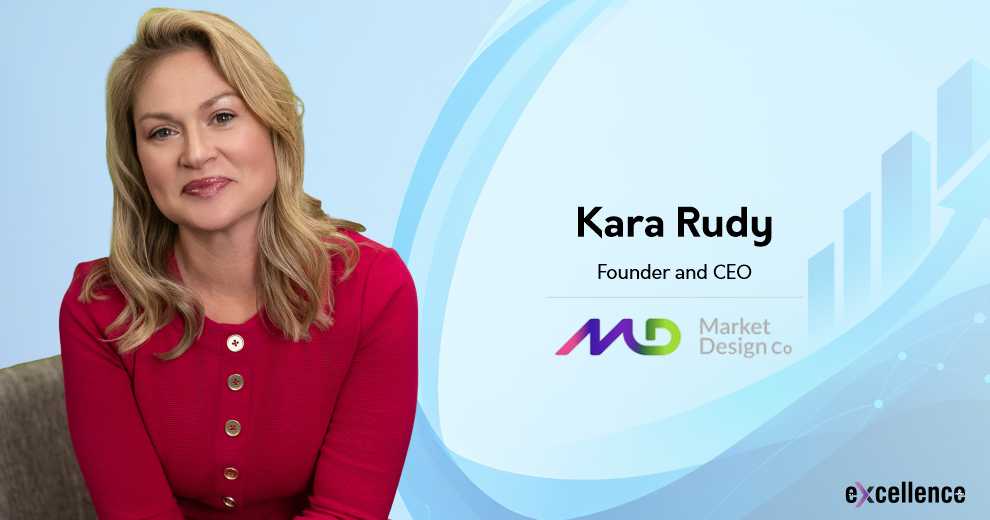
Leadership today is increasingly defined by the ability to navigate complexity while keeping people, purpose, and performance aligned. For Kara Rudy, that principle has been shaped by an unconventional career journey that began in web design, developed through nearly two decades in the IT channel, and eventually led to entrepreneurship and executive leadership.
Rudy is the Founder and CEO of MarketDesign Consulting, Inc., a boutique marketing and business consulting firm serving the IT channel. She also serves as Chief Marketing Officer of Compugen Systems Inc. and recently stepped down as Vice President of Marketing at Compugen Inc., one of North America’s largest privately owned IT solution providers. Her professional path has moved through individual contribution, management, executive leadership, entrepreneurship, and consulting, giving her a broad perspective on how organizations grow and how leaders evolve along with them.
A Career Built Through Curiosity
Rudy’s career began in web design at an engineering firm, where she discovered her talent for copywriting and design. Over nearly two decades in the IT reseller and channel ecosystem, she progressed from individual contributor to manager and C-suite leader. In 2018, a corporate restructuring prompted her to build something of her own. MarketDesign grew from a one-woman operation into a seven-figure consulting firm within five years before joining the Compugen Group in 2024. Her leadership philosophy evolved with the journey: own the work, then the team, and ultimately the organization that enables both, while focusing energy on what can be controlled and championing what truly matters.
What Basketball Taught Her About Leadership
Long before Rudy entered a boardroom, she was learning about leadership on courts and fields. Raised in a basketball family in Syracuse, New York, she played basketball alongside her father and brothers. She went on to play three sports in high school and two in college. Those experiences taught her discipline, structure, teamwork, resilience, and the importance of showing up consistently.
Sport also gave her some of her earliest opportunities to lead and taught lessons that continue to influence her professional life. She still coaches youth sports, creating an ongoing exchange between the lessons she has learned as a leader and what she continues to learn from younger athletes.
Her entrepreneurial journey came through a different kind of pressure. The acquisition that disrupted her corporate path effectively forced a decision. Rudy did not have a detailed entrepreneurial roadmap. Instead, she relied on confidence in her own ability to figure things out.
Turning a Clarity Problem into a Growth System
MarketDesign was founded around an observation Rudy continues to see across the IT industry: many solution providers do not necessarily lack capability. They struggle to communicate what they do, why it matters, and how their capabilities translate into measurable business outcomes. Her response has been to build a consulting model around clarity.
The company organizes its approach through P.A.T.H., representing Purpose, Accountability, Technology, and Human. Purpose creates alignment, accountability turns ambition into measurable progress, technology helps simplify complexity, and the human element keeps the focus on the people technology ultimately serves. Beneath this sits MarketDesign’s 6 Ps of Progress: people, process, platform, purpose, plan, and pipeline.
Rudy’s approach is grounded in practical experience. She has occupied many of the roles her firm now advises, including CEO, salesperson, and line-of-business leader. Her team brings similarly deep experience across marketing, sales, technology, service delivery, and business leadership.
That operator perspective shapes how MarketDesign works. Its consultants are not simply developing strategies for clients. They are also making sales calls, developing offerings, managing services, and remaining accountable for profitability. The result is a consulting model designed to connect business strategy with the realities of execution.
Replacing Long Strategy Cycles with Focused Action
One of Rudy’s strengths is facilitation. She enjoys bringing leadership teams together and helping them understand where they want the organization to go, while creating alignment among sales, marketing, People + Culture, and service leadership. That philosophy has influenced MarketDesign’s evolution toward focused sprints. Rather than spending months developing strategies that may never reach the market, the company increasingly works around one defined objective, a specific set of activities and deliverables, measurable touchpoints, and a clear path from awareness to action. Data has become central to this approach.
Rudy believes leaders need a clear understanding of their own organizations rather than generic industry benchmarks that may have little relevance to their people, processes, or operating environments. Her diagnostic-driven engagements are designed to establish where a client actually stands and then determine what should happen next. Artificial intelligence has accelerated that process. Rudy has used tools including Copilot, ChatGPT, and Claude to build new skills and design systems, while exploring how technology can reduce repetitive work and give people more time for higher-value thinking.
Authenticity as a Foundation for Leadership
Rudy is naturally fast-moving and idea-driven, but her leadership has evolved through learning when to step back and empower others. She separates the person from the role, recognizing that disagreements often stem from differing perspectives on responsibilities.
Her reminder, “not tonight,” reflects her commitment to delegation and balance. Through tools such as Delegate & Elevate, she helps employees focus on their highest-value contributions while giving others opportunities to lead. Her own leadership has similarly shifted from doing everything herself to equipping others with the clarity, tools, and space to succeed.
Building Teams Where People Can Own Their Strengths
For Rudy, strong workplace culture begins with connection, clarity, and trust. She aligns individual strengths with shared goals through meaningful dialogue, clear roles, scorecards, and regular one-to-one conversations. Her hiring philosophy is equally intentional. She seeks people who complement her strengths and bring expertise she does not possess, openly embracing the opportunity to learn from others. This approach creates a culture where employees can take ownership, contribute their strengths, and grow alongside the organization.
Navigating Three Hats Without Losing One Identity
Holding three roles across the Compugen Group of Companies has challenged Rudy to move seamlessly between different professional environments. She recalls one Tuesday in April when she had already navigated three distinct roles before lunchtime, each with its own expectations, language, and measures of success. The experience reinforced a central belief: authenticity is what creates continuity.
Rudy chooses to bring the same person into every room, regardless of the role she is playing. She considers this especially important for women, who often balance several professional and personal responsibilities at once. Her approach to change follows the same philosophy. Rather than dwelling first on what could go wrong, she asks herself, “What if it all works out?” The question helps her approach uncertainty with a more open mind and recognize change as an opportunity for growth.
A Seven-Figure Business Built Alongside a Larger Purpose
Building MarketDesign into a seven-figure consulting firm within five years stands among Rudy’s proudest professional achievements. What makes the accomplishment especially notable is the context in which it happened. She launched and grew the business while raising three young children, balancing entrepreneurial demands with the responsibilities of motherhood.
Her impact has also extended into causes beyond her own organization. Rudy helped raise more than $35,000 for cancer research, reflecting a broader philosophy that business success can create space for meaningful social contribution.
That same perspective shapes how she understands resilience. Rather than viewing it as a dramatic quality revealed during major challenges, Rudy sees resilience as something developed through everyday responsibility. It takes shape when the load feels heavier and a person consciously decides to keep going.
Women Leaders and the Value of Emotional Intelligence
Rudy believes women are helping reshape expectations around leadership by demonstrating that decisiveness and emotional intelligence can coexist. In the IT channel, she sees trust, clarity, and proof becoming increasingly important as buyers become more cautious about risk. Leaders who can listen, understand different perspectives, align people, and make difficult decisions are particularly relevant to this environment.
Her advice to aspiring women leaders begins with self-awareness and the willingness to ask for a place in the room. She has learned that listening can be more powerful than speaking simply to be heard. She also advocates asking for support early, building capacity before it becomes necessary, and allowing professional ambitions to coexist with the different seasons of life. Time, she believes, is the resource that cannot be replenished.
Preparing for an IT Industry Defined by Focus and Proof
Looking ahead, Rudy sees margin pressure, differentiation, and AI reshaping the IT channel. As traditional models face growing scrutiny, organizations must sharpen their focus, strengthen profitable capabilities, and use AI as a practical part of everyday operations.
For MarketDesign, this next chapter means helping mid-market IT services companies build stronger systems for growth, supported by offerings such as Found First, MDCompass, V.O.I.C.E, and managed HubSpot services.
For Rudy, however, the ultimate measure of leadership goes beyond business growth. She wants to leave behind stronger people, teams, and organizations that can continue building without her. Her legacy, therefore, lies in creating something capable of thriving even after she steps away.