
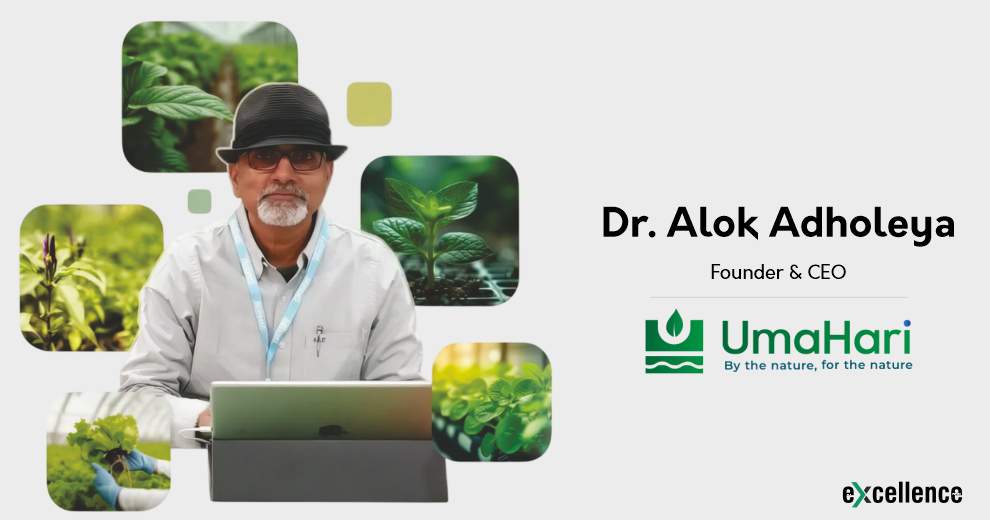
From mycorrhizal science and nanobiotechnology to a new generation of microbial agricultural products, Dr. Alok Adholeya (Founder and CEO of UmaHari LLC) is building a bridge between scientific discovery and practical farming. Through UmaHari, that decades-long pursuit is taking shape as a commercial platform designed to make biological solutions more accessible, scalable, and relevant to the realities of modern agriculture.
Long before biological inputs became a prominent part of the agricultural conversation, Dr. Adholeya was investigating mycorrhizal fungi, plant-microbe interactions, soil fertility, nutrient cycling and microbial technologies. His work has extended from fundamental research into field applications, technology development and commercialization. Springer describes him as having more than 40 years of experience in translational research, with more than 25 intellectual property rights developed and several technologies commercialized through technology transfer. The same profile records his extensive publication and book authorship record in the field.
Today, that scientific experience finds a commercial expression through UmaHari. The company positions itself around microbial technologies, mycorrhiza, biogenic nutrients, bacterial inoculants and biological formulations designed to support crop productivity and soil health.
From the Root Zone to the Real World
Dr. Adholeya’s career has been closely associated with mycorrhiza, the symbiotic relationship between certain fungi and plant roots. Arbuscular mycorrhizal fungi can extend the effective reach of a plant’s root system through fungal structures and can contribute to nutrient acquisition, particularly phosphorus, while supporting plant performance under certain environmental stresses. Research literature increasingly examines mycorrhizal systems as part of broader approaches to soil health, nutrient cycling and resource efficiency.
The biotechnology expert’s early work reflected this practical orientation. A TERI project led by Dr. Adholeya examined the isolation and characterization of efficient arbuscular mycorrhizal fungi, their propagation, their interaction with plant-growth-promoting rhizobacteria and their potential application under semi-arid and low-nutrient conditions. That research philosophy has remained remarkably consistent: understand biological systems deeply, identify what can be made useful, and then develop the technology required to take it beyond the laboratory.
It is a philosophy that has also informed his work in conservation and resource management. In the 1990s, a Center for Mycorrhizal Culture Collection was established at TERI under his work, building a repository of mycorrhizal cultures from diverse agro-ecological regions and environmentally vulnerable lands. The collection became a resource for research and further exploitation of agriculturally significant fungal diversity. That combination of science and application became a defining characteristic of his career.
A Scientist With a Commercial Lens
Scientific expertise alone does not create agricultural impact. Technologies must survive field conditions, demonstrate consistency, fit existing farm practices, reach distribution networks and deliver an economic proposition that makes sense to growers. Dr. Adholeya’s professional record reflects an unusual emphasis on that translation.
In 2010, he received the Innovation for India Award from the Marico Innovation Foundation for translational research in sustainable agriculture. The recognition highlighted his ability to connect fundamental biological research with field-level agricultural application, particularly through mycorrhiza-based and microbial technologies designed to improve soil health, nutrient-use efficiency, and long-term crop productivity.
In 2004, the Ministry of Science and Technology, Government of India, conferred on him the Biotech Product and Process Development and Commercialization Award for mycorrhiza technology development and commercialization. The award recognized his contributions to the development, validation, and large-scale commercialization of mycorrhiza-based technologies and his role in translating fundamental research into scalable, farmer-ready biological products.
Earlier recognition included the Gwalior Ratna in 2000 for scientific excellence and outstanding contributions to biological research, particularly in microbiology and agricultural sciences. The Paryavaran Sanrakshan Samman in 1999 recognized contributions to environmental protection and ecological sustainability, including work involving soil ecology, beneficial microorganisms, and plant-microbe interactions.
The Young Scientist Award, also conferred in 1999 by the Government of India, recognized his early-career contributions to agricultural biotechnology, particularly in soil microbiology, mycorrhizal symbiosis, and sustainable crop productivity. He has also held leadership roles in the mycorrhizal research community, including serving as President of the 7th International Conference on Mycorrhiza.
That background helps explain the architecture of UmaHari. The company is not presented simply as a manufacturer of biofertilizers. Its platform encompasses research and formulation, field trials and validation, OEM and custom manufacturing, technology transfer, technical support, marketing and sales. In other words, it attempts to address the entire journey from biological discovery to market deployment.
International and Academic Recognition
Dr. Adholeya’s professional recognition reaches well beyond India, reflecting the international scope of his contributions to scientific research and sustainable agriculture. He was named a finalist for the Australia India Science, Research and Development Award through the Indo-Australian Business Council. The recognition acknowledged his work in translational research and scientific innovation, particularly his contributions to mycorrhizal biology and sustainable agriculture, as well as his efforts to bridge fundamental research with industrial application and commercialization.
The agritech leader’s contribution to the field is also reflected in the establishment of the UMAHARI Award, formally described as the Ultimate Mycorrhiza Application for Harnessing Agriculture Resources Integration. Presented at ICOM conferences, the award recognizes application-oriented research in mycorrhiza and honors excellence across both oral and poster presentations. The initiative was established in memory of Dr. Adholeya’s parents.
His academic achievements include his appointment as Honorary Professor at Deakin University in Australia, a position he held from 2010 to 2021. Dr. Adholeya has also received honorary advisor appointments and mementos of honor from organizations across the world, further reflecting the international regard for his work. His expertise has also placed him on prominent scientific and agricultural platforms internationally.
Among his notable keynote engagements were “Mycorrhizal Symbiosis: The Future of Sustainable Agriculture” at the International Conference on Plant Science in Rome in March 2023; “Nanotechnology Revolution in Agriculture” at the Global Agri-Tech Summit in San Francisco in October 2022; “Biofertilizers for Climate-Resilient Farming” at the World Sustainable Agriculture Forum in Amsterdam in June 2022; and “Soil Health and Food Security” at the UN Food and Agriculture Conference in Geneva in April 2021.
His professional record further includes his tenure as President of ICOM7 in New Delhi in 2013, an invited speaking engagement at the AMI Conference in 2023, a keynote address at the Indian Seed Congress in 2020, participation as a speaker at the Global Summit on Regulatory Science, and involvement in the World Sustainable Development Summit. Together, these engagements underscore the breadth of his contribution to international conversations on agricultural science, biotechnology, soil health, and sustainable farming.
UmaHari: Turning Biological Potential Into a Product Platform
UmaHari’s proposition begins with a straightforward idea: agriculture can work more intelligently with biological systems. Its product portfolio includes mycorrhizal formulations, biogenic bacterial inoculants, biogenic nutrients, MYCOBAC and Crop NutriShield. The company also highlights BioGuru™ Mycorrhiza and Solid State Fermentation Technology as part of its technology portfolio. Each category addresses a different part of the agricultural equation:
- Mycorrhiza focuses on the plant-root relationship and nutrient acquisition. UmaHari describes its mycorrhizal product line as being based on next-generation Solid State Fermentation Technology.
- Biogenic Bacterial Inoculants bring beneficial microorganisms into crop nutrition strategies. The company’s published specifications describe applications through seed treatment, root dipping, soil application, irrigation systems and other delivery methods, with formulations designed for compatibility with seed-coating polymers, fungicides and other agricultural inputs.
- Biogenic Nutrients take a different approach to plant nutrition by using biologically derived inputs intended to improve nutrient availability and utilization. UmaHari describes these concentrates as suitable for seed coating, in-furrow applications, drip irrigation, greenhouses, nurseries and other production environments.
- MYCOBAC and Crop NutriShield broaden the platform toward integrated plant nutrition and crop resilience, creating the possibility of combining microbial and nutritional approaches rather than treating each agricultural challenge as an isolated problem.
This breadth matters commercially. A farmer does not experience agriculture as a collection of scientific disciplines. The farmer experiences a crop that must germinate, establish roots, access nutrients, tolerate environmental stress, resist biological pressure and produce a commercially viable harvest. A successful biological product therefore has to fit into that entire chain.
BIOGuru™ 3F Pro: A Sustainable Approach to Fish Nutrition
BIOGuru™ 3F Pro-Biofermented Fish Feed reflects Dr. Adholeya’s broader philosophy of translating biological science into practical, sustainable products. Developed as a plant-based, vegan and biofermented fish feed, it eliminates fishmeal, fish oil, animal-derived ingredients, GMOs and artificial additives.
Its distinctive proposition lies in combining biofermentation and probiotics to support digestion, nutrient absorption, fish growth and immunity. The formulation is also positioned to reduce waste and contribute to better water quality, making it relevant to both aquarium fish and the wider aquaculture sector.
What sets BIOGuru™ 3F Pro apart is its attempt to bring nutrition, fish health and environmental responsibility into a single feed solution. By developing an alternative to conventional fishmeal-based nutrition, the product reflects Dr. Adholeya’s continuing focus on using biological processes to improve resource efficiency and create commercially relevant solutions for sustainable agriculture and aquaculture.
Performance Meets Practicality
The strongest case for biological agricultural products will ultimately be built in the field. UmaHari’s commercial positioning reflects that reality. Its websites emphasize yield, return on investment, reduced input dependence, soil health and compatibility with existing agricultural practices. The company states that its products have undergone demonstration trials across regions including the United States, Europe, India and Australia, and reports ROI outcomes associated with some of its product applications.
These claims should naturally be evaluated product by product and crop by crop, because biological performance is influenced by soil, climate, crop variety, management practices and application method. Yet the underlying commercial question remains clear: can biological inputs produce sufficiently consistent value for farmers and agricultural businesses to adopt them at scale?
UmaHari’s answer is to build validation into the business model itself. Its India platform describes a methodology that moves through research and formulation, field trials, OEM and custom manufacturing, support and scaling, followed by technology customization and transfer. The company also promotes product validation and multi-soil testing as part of its approach. This emphasis on validation may become increasingly important as the biologicals market matures.
The future of agricultural biologics will depend on more than attractive sustainability narratives. Farmers need predictable performance. Distributors need product consistency. Manufacturers need shelf stability and quality control. Regulators require evidence and compliance. Agribusinesses need economics that withstand scrutiny. UmaHari’s model is designed around that intersection.
Building a Business Around Collaboration
Another distinguishing feature of UmaHari is its emphasis on collaboration. The company offers contract manufacturing and OEM services, enabling agricultural brands to work with its biological formulations and manufacturing capabilities. It also offers product validation, marketing and sales support. That creates an ecosystem model rather than a single-product business.
For established agricultural companies, the attraction may lie in accessing biological formulation expertise without having to build every capability internally. For emerging brands, OEM manufacturing and validation can reduce some of the barriers involved in bringing biological products to market. For technology owners, the platform offers another route toward commercialization and geographic expansion.
This model is particularly relevant in a market where scientific discovery, manufacturing expertise, regulatory requirements and farmer adoption must work together. The company describes its activities as serving markets across North America, Latin America, Asia and beyond, while its product pages reference trials across multiple international agricultural environments.
Leadership Rooted in Scientific Continuity
There is another dimension to Dr. Adholeya’s story that is easy to overlook. His leadership is not built around a sudden entry into agriculture. It has evolved from decades spent studying the biological relationships that make agriculture possible. That continuity matters. He has served as Chief Editor of Mycorrhiza News for more than three decades, according to his current profile, and has participated in international mycorrhizal research and knowledge networks. He has also guided doctoral researchers and contributed extensively to scientific literature and books.
In 2024, Springer listed Dr. Adholeya among the editors of Arbuscular Mycorrhizal Fungi in Sustainable Agriculture: Inoculum Production and Application, further reflecting his longstanding engagement with the field.
This makes his role at UmaHari more than a conventional founder story. It represents the next stage of a scientific career: taking accumulated knowledge, relationships, intellectual property and technological experience and placing them inside a commercial structure capable of reaching markets.