
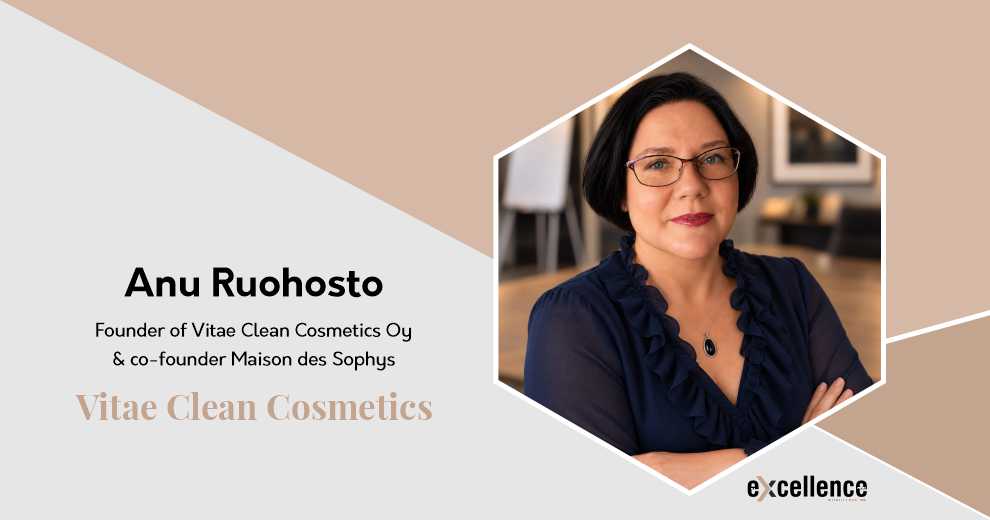
In an era when the boundaries between beauty, science, health and wellbeing are becoming increasingly interconnected, meaningful progress requires more than attractive concepts, fashionable ingredients or compelling claims.
For Anu Ruohosto, Founder of Vitae Clean Cosmetics Oy and co-founder of Maison des Sophys, the foundation has always been deeper: knowledge, evidence, formulation expertise and an enduring respect for nature.
With more than 25 years of experience in the beauty industry, Ruohosto has built her career at the intersection of cosmetic chemistry, botanical science, natural cosmetics, product development, education and entrepreneurship. Along the way, she has also trained professionals, written and published expert articles, evaluated cosmetic ingredients and finished products in international competitions, and worked with several cosmetic certification systems.
Her professional philosophy can be expressed through one simple principle: nature provides knowledge and possibility. Science gives us the tools to understand it. Formulation brings everything together.
Ruohosto has been a pioneering voice in natural cosmetics because she has consistently challenged the idea that “natural” should mean accepting compromises in quality, performance or sensory experience. For her, natural cosmetics should meet the same professional expectations as any other well-developed cosmetic product. A formulation must be safe, stable, functional, pleasurable to use and technically sound. Naturalness alone is never enough.
From Scientific Curiosity to a Larger Purpose
Ruohosto’s professional journey began with studies in cosmetic chemistry and botanical science, creating a foundation for years of work with ingredients, formulations and product development. Her fascination with plants developed alongside an equally strong interest in chemistry.
Rather than seeing nature and science as opposing philosophies, she learned to see them as complementary ways of understanding the same world. Traditional botanical knowledge can offer valuable direction. Plants have been used for generations, often long before modern analytical methods existed. That accumulated knowledge represents an important starting point.
Modern science provides the means to explore that knowledge more deeply. Chemical composition, concentration, extraction methods, stability, biological activity and safety can all be studied systematically. Through scientific investigation, traditional knowledge can be examined, refined and adapted to contemporary requirements.
For Ruohosto, this relationship is fundamental. Science does not erase the value of traditional knowledge. Instead, it creates a way to understand that knowledge with greater precision and determine how it can be applied responsibly in modern cosmetic development.
This perspective has remained one of the defining foundations of her career.
“I believe science and nature are not opposites.”
Her approach reflects a belief that the future of natural cosmetics lies in bringing these two worlds into a thoughtful conversation. Nature offers an extraordinary reservoir of knowledge and possibility. Science provides the methods to investigate, validate and strengthen what nature can teach us.
Looking Beyond the Label of “Natural”
Ruohosto’s botanical expertise is particularly evident in the way she evaluates natural ingredients. The fact that a substance originates from nature does not automatically determine its safety, gentleness, effectiveness or suitability for a particular formulation.
Natural materials are chemistry too. Their behaviour depends on many factors: chemical composition, concentration, purity, pH, extraction method, stability, preservation and interaction with other materials.
This is one reason Ruohosto has spent much of her career advocating for a more technically demanding approach to natural cosmetics. A natural cosmetic product should not be regarded as a lesser or simpler version of conventional cosmetics. It should perform, feel good, remain stable and meet the same professional standards expected from any high-quality cosmetic product.
For her, the word “natural” establishes a philosophy around ingredient sourcing and formulation. It does not lower the expectations placed on the finished product.
“Natural cosmetics should not be an easier version of cosmetics. They should be expected to deliver the same level of quality, functionality and professional performance.”
A beautiful botanical story may provide inspiration, but it cannot compensate for a weak formula. A product can contain impressive plant extracts and still fail if the preservation system is unsuitable, the texture is unstable, ingredient interactions are poorly understood or supporting materials have been selected primarily for marketing reasons rather than functionality.
Ruohosto’s approach therefore brings natural cosmetics firmly into the realm of professional formulation science.
The Formulation Is a System
One of the most important principles in Ruohosto’s work is that a cosmetic formula must be understood as a complete system. An ingredient cannot be evaluated only in isolation.
Preservatives, emulsifiers, solvents, texture modifiers, active ingredients, botanical extracts and supporting materials all influence the final product. Every choice affects something else.
Concentration, pH, temperature, manufacturing conditions, raw-material purity and preservation can change the behaviour of individual ingredients and of the formulation as a whole. Two materials that work well independently may create an excellent synergy when combined correctly.
In another formulation, different interactions can reduce stability, change performance or alter the safety profile. Under certain conditions, unwanted reaction products can also form. This is why ingredient compatibility is central to Ruohosto’s formulation philosophy.
The most important question is not simply whether an ingredient is interesting. The real questions are: Why is it here? What function does it serve? How does it behave with the other materials? And what does it contribute to the finished product?
“Every ingredient should have a reason to be in the formulation.”
This systems-based perspective is central to her understanding of quality. Formulation is not a matter of assembling a collection of appealing ingredients. It is the careful construction of a complete product in which every component has a meaningful role.
A successful natural cosmetic therefore requires the same discipline as any professionally developed cosmetic product. The origin of an ingredient matters, but so do its behaviour, compatibility, concentration, stability and contribution to the finished formula.
From Knowledge to Professional Expertise
Ruohosto’s work has extended far beyond product formulation. Throughout her career, she has trained professionals in cosmetics, written and published expert articles, and contributed to the broader understanding of ingredients, formulation quality and natural cosmetics.
Education has become an important part of her professional identity. For Ruohosto, knowledge becomes more valuable when it can be shared, questioned and developed further. Her experience as an educator has allowed her to communicate complex cosmetic science while encouraging professionals to approach ingredients and formulations with curiosity and critical thinking.
Her expertise has also taken her into international product and ingredient evaluation. She has served as an evaluator of cosmetic raw materials and finished products in international competitions, where products must be examined beyond branding, packaging and first impressions.
The quality of the ingredients, the logic of the formulation, the sensory experience and the overall performance all have to withstand professional scrutiny. Her experience with several cosmetic certification systems has added another dimension to this perspective. Certification can provide valuable standards, structure and transparency, particularly in an industry where consumers increasingly seek clarity around product claims and ingredient choices.
At the same time, Ruohosto places professional judgement at the centre of quality assessment. Certification is one part of the broader picture. A product still needs to demonstrate sound formulation, safety, stability, functionality and a satisfying user experience. This breadth of experience has helped shape her ability to view cosmetics from multiple perspectives: as a scientist, educator, formulator, evaluator, entrepreneur and advocate for responsible natural beauty.
Vitae Clean Cosmetics: Turning Ideas into Real Products
This philosophy became especially important through Vitae Clean Cosmetics Oy. Many founders begin with an inspiring idea, a strong brand vision or a compelling botanical concept. But transforming that idea into a professionally developed cosmetic product requires another level of expertise.
There is a gap between inspiration and technical reality. Ruohosto’s work is often about bridging that gap.
The process begins with understanding the brand, the intended consumer and the experience the product is designed to create. From there, the concept must be translated into technical requirements involving ingredients, formulation structure, texture, preservation, performance, manufacturing and quality.
Product development is inherently collaborative. For Ruohosto, it represents a dialogue between creativity and science.
The most rewarding moment may be when an idea that originally existed only in someone’s imagination becomes a tangible product. But reaching that point can require repeated testing, reformulation and patience. A formula rarely arrives fully formed.
Unsuccessful versions can provide valuable information. Each test reveals something about the system: what works, what does not and what can be improved. This has influenced Ruohosto’s broader view of progress. Development does not always mean adding something new. Sometimes the most intelligent solution is to simplify, remove unnecessary elements and allow the essential components of a formulation to work more effectively together.
When Fragrance Becomes a Personal Story
Ruohosto’s scientific background has never limited her work to what can be measured in a laboratory. She is equally fascinated by beauty as a sensory and emotional experience. This is particularly visible in her relationship with fragrance.
If Skinsophy represents skin science, botanical knowledge and intelligent formulation, Scentsophy explores another dimension of beauty: emotion.
Scent has the ability to connect us instantly with memories, people and places. A fragrance may begin with chemistry and raw materials, but its meaning develops through human experience.
For Ruohosto, fragrance is therefore much more than something worn on the skin. It can become a form of emotional storytelling and personal expression.
Her approach brings chemistry and creativity into the same conversation. Chemistry provides an understanding of materials, composition, balance and behaviour. Creativity gives the fragrance its identity.
A concept may begin with a memory, an atmosphere, a place or an emotion and then be translated into the language of scent. The creator can provide the initial inspiration. The wearer ultimately gives the fragrance its personal meaning.
Leadership Grounded in Knowledge and Integrity
Behind the scientist, formulator and entrepreneur is also a leadership philosophy based on knowledge, trust, respect and transparency. Ruohosto places particular importance on long-term relationships with clients, collaborators and teams. Meaningful development rarely happens in isolation. Curiosity remains equally important.
Leadership, in her view, requires a willingness to continue learning and to remain open to new evidence and perspectives. Her professional interests may appear broad, but they are connected by the same underlying logic: Science provides structure. Entrepreneurship turns ideas into action. Creativity opens possibilities. Purpose connects them.
The important question is always why something should exist and what genuine value it can bring. Her more than 25 years in the beauty industry have also taught her that expertise is built through experience as much as formal knowledge. Working across formulation, education, evaluation, certification and entrepreneurship has given her a wider view of the industry and the responsibility that comes with developing products for consumers.
Entrepreneurship has taught Ruohosto that progress rarely follows a straight line. Uncertainty, setbacks and unexpected outcomes are part of the process. Resilience comes from learning, adapting and continuing to believe in the purpose behind the work. Her definition of success has therefore expanded beyond business growth. Commercial achievement matters, but so do meaningful work, creativity, knowledge-sharing, integrity and positive impact.
A More Responsible Future for Beauty
Ruohosto believes the next chapter of the beauty industry will require responsibility to become increasingly tangible. Broad sustainability promises are no longer enough. Responsible development must take into account sourcing, formulation, manufacturing, packaging, logistics, product performance and the complete life cycle of a product.
There is rarely one perfect solution. A technically excellent material may not yet be scalable. A highly sustainable option may create challenges in stability or sensory performance. A natural ingredient may appear ideal from a marketing perspective while proving unsuitable for the formulation itself.
Progress therefore depends on informed decisions, transparent trade-offs and continuous improvement. For Ruohosto, responsibility begins with knowledge. The same principle applies to botanical ingredients. The future of natural cosmetics is not necessarily about using more plants. It is about understanding plants more intelligently.
Developments in plant chemistry, biotechnology, extraction technologies and biological research are creating increasingly precise ways to evaluate botanical materials. Traditional plant knowledge provides an important foundation. Science gives us the ability to understand what compounds are present, how they behave and how they can be used effectively and responsibly.
This relationship between historical knowledge and modern evidence remains central to Ruohosto’s work. It also captures the philosophy that has guided her professional journey: nature provides the knowledge, science helps strengthen and validate it, and formulation brings that understanding into a complete, functional product.
Maison des Sophys and the Next Chapter
The year 2026 represents an especially interesting moment for beauty and wellbeing. Consumers increasingly expect products to combine performance with transparency, responsibility, personalization and emotional relevance.
Scientific and technological developments are also creating new possibilities for understanding ingredients, formulations and individual needs.
Ruohosto is particularly interested in botanical science, biotechnology, precision formulation, responsible sourcing, personalization and the relationship between beauty and holistic wellbeing. At the same time, she sees a growing appreciation for simplicity.
Progress does not always mean creating a more complicated product. Sometimes creating something smarter and more purposeful means adding less.
These ideas come together through the wider vision of Maison des Sophys. Maison des Sophys creates a home for Ruohosto’s interests in botanical chemistry, skincare, fragrance, beauty, science and wellbeing.
Through Scentsophy, she explores fragrance, emotion and personal expression. Through Skinsophy, she brings together skin science, botanical knowledge and intelligent formulation.
The ambition is not simply to create more products. It is to create products with a clear reason to exist: products that are technically sound, sensorially meaningful and grounded in both knowledge and experience.
Learning, Curiosity and the Courage to Keep Building
After more than 25 years in the beauty industry, Ruohosto remains motivated by one simple fact: there is always more to discover.
Science evolves. Ingredients evolve. Technology evolves. Consumer expectations change. Our understanding of beauty, wellbeing and nature continues to develop.
For Ruohosto, expertise is therefore not a finished state. Remaining an expert means continuing to learn. It also means being willing to reconsider an assumption when better evidence becomes available.
Her professional challenges have reinforced the importance of patience, adaptability and discernment. Setbacks have often become sources of information. They reveal what can be improved and help shape the decisions that follow.
Curiosity also feeds creativity. Inspiration can emerge from science, nature, ingredients, fragrance, people, travel, conversations or everyday observations. Ruohosto values moments when analytical thinking can give way to observation and exploration.
This mindset also shapes her advice for the next generation. Young professionals entering science, beauty and entrepreneurship should build genuine knowledge while trusting their curiosity. A career does not need to follow a straight line.
Scientific thinking and creativity can exist side by side. In fact, some of the most meaningful work happens precisely where they meet.
For future leaders, Ruohosto identifies curiosity, adaptability, critical thinking, emotional intelligence and integrity as essential qualities. Just as importantly, leaders will increasingly need to distinguish meaningful development from hype.
They must be able to ask difficult questions and communicate complex scientific ideas in ways people can understand. Visibility should never be confused with expertise. Real expertise is built through knowledge, experience, questioning and the willingness to continue learning.
At the heart of Ruohosto’s philosophy is a principle that has accompanied her from cosmetic scientist and educator to entrepreneur and visionary leader:
“Understand nature. Strengthen knowledge through science. Never compromise the integrity of the formulation.”
It is a philosophy that brings together the defining threads of her career. Nature provides a source of knowledge. Science provides the means to investigate and strengthen that knowledge. Formulation turns understanding into something tangible, functional and meaningful. And perhaps, above all:
“Never stop learning, and never lose sight of why you started.”