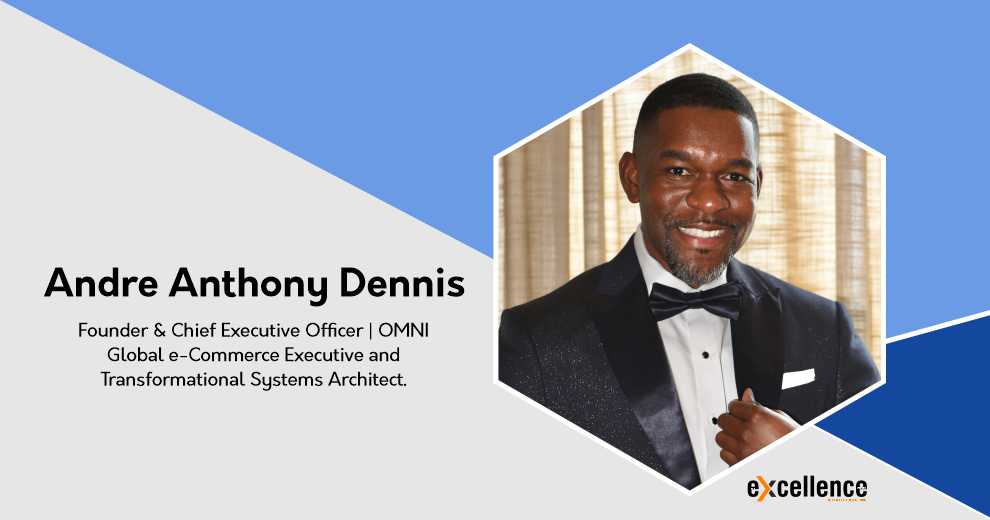
As global commerce enters the Age of Intelligent Commerce, visionary leaders are redefining how organizations harness technology to create lasting value. At the forefront of this transformation is Andre Anthony Dennis, Founder & Chief Executive Officer of OMNI, Global e-Commerce Executive, and Transformational Systems Architect. With more than two decades of enterprise leadership, he has driven artificial intelligence (AI), robotics, and intelligent supply chain transformation for global organizations including Amazon, Apple, Walmart, PayPal, UPS, EssilorLuxottica, Gucci, and Staci Americas. Known for solving complex operational challenges, he has advanced robotics deployment, enterprise AI integration, intelligent reverse logistics, customer experience transformation, and next-generation 5PL operating models.
From the Front Lines to the Boardroom
Dennis has built his career on a simple yet enduring belief: every organization has the potential to become more intelligent, more adaptive, and more human. This philosophy has guided his journey from front line operations to enterprise leadership and ultimately to founding OMNI, an Enterprise Intelligence Company dedicated to helping organizations design the next generation of intelligent enterprises.
His professional career began in the food and beverage industry with Aramark and Compass Group, where the versatile leader developed the discipline, operational excellence, and leadership principles that continue to define his approach today. While many viewed those early roles as routine, Dennis regarded them as opportunities to build a strong professional foundation while earning his college education through employers that invested in his future. Those experiences reinforced his belief that lasting success is built on character, continuous learning, and a willingness to lead from the ground up.
As his career evolved, he expanded his expertise across education, healthcare, luxury retail, enterprise retail, global e-commerce, logistics, robotics, and technology. Each industry broadened his understanding of how organizations operate, how people create value, and how intelligent systems can transform performance when designed with purpose.
A defining chapter of his career came at Amazon, where he held leadership roles across First Mile, Inbound Operations, Cross Dock, Manager on Duty, and Last Mile Delivery Operations. Serving as both an Amazon Fulfillment Engine (AFE) Site Subject Matter Expert and Regional Subject Matter Expert, he helped modernize operational training while supporting enterprise-scale fulfillment, transportation, and delivery networks. The experience reinforced his conviction that resilient organizations are built not by technology alone, but through the combination of intelligent leadership, adaptive systems, and empowered people.
The multi-faceted leader carried that conviction into Happy Returns during its growth phase and subsequent acquisition by UPS, and later to Staci Americas, where decades of operational experience began to crystallize into the frameworks that would eventually become OMNI.
The Philosophy: Enterprise Intelligence
At the heart of Dennis’s work is a philosophy he defines as Enterprise Intelligence, the belief that the future of business will belong not to organizations that simply adopt more technology, but to those capable of connecting data, people, processes, and intelligent systems into adaptive ecosystems that enhance resilience, agility, and long-term value.
He views AI as one of the greatest opportunities of the modern era, provided it is implemented responsibly. Rather than replacing human potential, technology should amplify it. This philosophy continues to shape his work in Decision Intelligence, Adaptive Enterprise Architecture, and Fifth-Party Logistics (5PL), frameworks designed to help organizations navigate increasing complexity while remaining resilient, ethical, and people-centered.
For him, leadership is measured not by the technologies an organization deploys or the scale it achieves, but by its ability to learn, adapt, and create meaningful opportunities for the people it serves. Through OMNI, Dennis continues to pursue that vision, helping organizations become more intelligent, resilient, innovative, and ultimately, more human.
OMNI: The Enterprise Intelligence Company
OMNI was founded on a simple yet transformative belief: the future belongs to organizations that learn faster than change itself. After more than two decades of leadership across food service, healthcare, education, luxury retail, global e-commerce, logistics, robotics, and technology, Dennis recognized a common challenge. While organizations were investing heavily in AI, automation, and digital technologies, many continued operating through fragmented business models designed for a previous era. Technology was advancing faster than the enterprise itself. That realization led to the launch of OMNI in 2020. Originally established as OMNI Consulting, the company has evolved into an Enterprise Intelligence Company focused on helping organizations build adaptive, intelligent enterprises capable of thriving in an increasingly complex world.
Rather than treating AI, robotics, automation, enterprise architecture, predictive analytics, and supply chain operations as separate disciplines, OMNI integrates them into a unified enterprise operating model. Its philosophy is clear: it does not build smarter departments. It designs intelligent enterprises. The company believes today’s business challenges from supply chain disruption and cybersecurity threats to labor shortages, geopolitical uncertainty, and rapidly changing customer expectations cannot be solved through isolated optimization. Instead, they require Enterprise Intelligence: an ecosystem where technology, strategy, operations, leadership, and culture continuously learn from one another.
Central to OMNI’s approach is a human-centered philosophy. While AI is a powerful enabler, the company believes technology should amplify human capability rather than replace human judgment. Sustainable competitive advantage, it argues, comes from combining machine intelligence with ethical leadership, operational excellence, and a culture of continuous learning.
Today, OMNI serves organizations across manufacturing, retail, logistics, healthcare, financial services, technology, aerospace, government, defense, and consumer products. Its portfolio includes solutions such as OMNI Intelligence™, OMNI Supply™, OMNI Robotics™, OMNI Commerce™, OMNI Nexus™, OMNI Vision™, and OMNI People™, each designed to help organizations operate with greater intelligence, resilience, and agility.
Guided by the principles of Character before Competence, Service before Self, People before Process, and Purpose before Position, OMNI differentiates itself from traditional consulting firms and software providers by focusing on enterprise-wide intelligence rather than departmental optimization.
A Vision for the Next Decade
Dennis argues that traditional supply chains were engineered to move products; the ones now taking shape are engineered to move intelligence adaptive ecosystems in which every supplier, facility, transportation link, and customer interaction feeds a continuously learning enterprise. He calls this shift the Age of Intelligent Commerce, in which AI functions as an enterprise’s intelligence layer, anticipating disruption and enabling faster decisions, while automation evolves from repetitive task execution into something more collaborative.
The next phase of digital transformation, in his view, isn’t about deploying more technology. It’s about redesigning how enterprises operate. Decision Intelligence sits at the center of that redesign, turning operational data into timely, trustworthy decisions before risks fully materialize. Robotics and cybersecurity reinforce the system, with cybersecurity increasingly framed not just as IT hygiene but as protection for decision integrity and organizational trust.
Still, Dennis insists the future stays fundamentally human. Pattern recognition and automated execution are AI’s strengths but purpose, ethics, creativity, empathy, and wisdom remain distinctly human ones. The organizations that lead going forward, he argues, won’t be the ones with the most technology, but the ones that integrate intelligence across the enterprise while protecting the culture and trust that empower their people.
AI Innovation Without the Buzzwords
At OMNI, innovation isn’t defined by any single AI model or software platform. It’s defined by an architecture that lets intelligence move freely across an organization. The company’s Enterprise Intelligence framework combines AI, Decision Intelligence, predictive analytics, automation, cybersecurity, enterprise architecture, and human-centered leadership into one operating model that converts data into business outcomes.
Decision Intelligence sits at the center, helping organizations turn raw operational data into faster decisions by spotting patterns and weighing scenarios. Adaptive Enterprise Architecture complements it, allowing businesses to learn continuously from their own activity rather than simply reacting to it. OMNI also applies AI to demand forecasting, inventory optimization, and capacity planning, and Dennis is careful to draw a line between automation and intelligence: automation speeds up execution, AI improves understanding, and the two together produce smarter responses to change, not just faster ones.
Cybersecurity is embedded as a foundational capability, ensuring the integrity of interconnected intelligent systems, while Human-Centered AI philosophy positions technology as a partner that enhances human judgment, collaboration, and strategic decision-making rather than replacing it.
Solving Industry Challenges
One of the biggest misconceptions in modern supply chains, Dennis says, is treating disruption as temporary. Geopolitical instability, labor shortages, cybersecurity threats, climate events, and shifting trade policy have become permanent operating conditions, not occasional shocks and that reality shaped OMNI’s entire premise. Rather than help companies react faster, he wants to help them build systems that learn and adapt before disruption turns into crisis, by connecting intelligence across procurement, manufacturing, logistics, finance, cybersecurity, and leadership.
That philosophy was forged under pressure. While leading one of Amazon’s largest fulfillment operations during a Peak season, Dennis’s team faced a staffing shortfall of more than 350 associates and management turnover near 90 percent. Through operational analytics, Lean methodologies, and leadership development, the team still delivered a 9.3 percent productivity increase, a 16.4 percent year-over-year performance gain, a 24 percent reduction in Peak operating costs, and more than $1.18 million in annualized savings, alongside record associate engagement. “Resilience is not measured by how an organization performs when fully staffed,” he says. “It is measured by how intelligently it adapts when it isn’t.”
That same logic extends to sustainability. Rather than framing environmental responsibility and operational performance as a trade-off, he argues intelligent enterprises can optimize transportation, inventory, energy use, and resource allocation at the same time, cutting waste while building more resilient supply chains.
Leadership in the Digital Era
Dennis pushes back on the idea that digital transformation is fundamentally a technology initiative. In his view, it starts with leadership and culture, and organizations become innovative not because they buy new tools, but because they build environments where people are trusted to learn, challenge assumptions, and improve continuously. Technology, he says, simply accelerates whatever culture already exists.
He believes trust creates psychological safety, psychological safety sparks curiosity, and curiosity drives innovation and that some of the most valuable operational improvements come from front line teams, not executive boardrooms. The OMNI’s Human-Centered AI approach follows the same logic: AI finds patterns and automation speeds up execution, but people supply context, purpose, and accountability.
This thinking underpins what he calls The Dennis Doctrine: Character Before Circumstance, Learn Without End, and Leave It Better. The versatile leader measures his own success not just by business outcomes, but by the leaders he’s helped develop along the way and he predicts the organizations that define the next decade won’t be the ones with the most advanced AI, but the ones with the strongest cultures of continuous learning.
Turning Data Into Decisions
The modern enterprise is not constrained by a lack of data—it is challenged by a lack of decision clarity. According to Dennis, the true value of data lies not in its volume, but in its ability to drive intelligent decisions.
This belief underpins OMNI’s Decision Intelligence framework, which integrates AI, predictive analytics, enterprise architecture, operational expertise, and human judgment to help organizations transform information into strategic action. Built around three essential questions: What is happening? Why is it happening? What should we do next?, the framework moves beyond traditional reporting to deliver actionable, enterprise-wide intelligence.
Drawing on decades of leadership across complex operations, the multi-faceted leader believes the strongest organizations are not those with the most data, but those that consistently make the best decisions. From anticipating supply chain risks and improving forecasting to optimizing inventory and strengthening customer experiences, Decision Intelligence enables leaders to act with greater speed, clarity, and confidence.
Sustainability & Responsible Innovation
Dennis frames sustainability not as a compliance checkbox but as an intelligent operating capability, a way to prevent waste before it happens rather than report on it afterward. In his telling, every unnecessary shipment or idle asset reflects intelligence that arrived too late. AI, predictive analytics, and Decision Intelligence improve forecasting and resource allocation, producing enterprises that use fewer resources while becoming more profitable.
Drawing on experience contributing to organizations that earned ISO 27001:2022 certification, Great Place to Work recognition, and a Silver EcoVadis rating, he has built his sustainability thinking around four pillars: Intelligent Operations, Trusted Enterprises, Human Flourishing, and Sustainable Impact. The goal, as he puts it, is building wiser organizations, not just faster ones.
Impactful Milestones & Recognitions
Rather than viewing awards as milestones, Dennis sees them as evidence of ideas that inspire progress and create lasting value. That perspective defines OMNI, whose ambitious vision is anchored in decades of experience transforming enterprises, modernizing supply chains, advancing digital commerce, and driving operational innovation.
Throughout his career, he has received numerous international honors, including recognition as a Who’s Who Distinguished Leader Honoree, induction into the Passion Vista Hall of Fame, inclusion among Elite Publishing’s Top 100 Experts in Robotics, the World Peace & Diplomacy Organisation Medal of Honor, and recognition as an award-winning expert in logistics, automation, and digital commerce. More recently, he has been named Caribbean Legacy Architect of the Year and Jamaica’s Global Business Visionary to Watch, reflecting the growing global interest in Enterprise Intelligence and human-centered leadership.
Beyond industry recognition, the versatile leader has served as an advisor to institutions including the University of California, Riverside, Seton Hall University, and the University of San Francisco, underscoring his commitment to developing future business leaders.
Dennis considers his most meaningful achievements to be the measurable outcomes delivered throughout his career: driving operational transformation, productivity gains, multimillion-dollar savings, customer experience improvements, leadership development, and organizational resilience. Contributing to organizations that achieved ISO 27001:2022 certification, Great Place to Work recognition, and a Silver EcoVadis sustainability rating further reinforced his belief that cybersecurity, employee engagement, sustainability, and operational excellence are interconnected outcomes of intelligent enterprise design.
Advice to Future Leaders
Dennis believes the greatest advice he can offer the next generation is simple: do not spend a career chasing technology, spend it learning how to think. While AI, robotics, and industries will continue to evolve, curiosity, adaptability, and sound judgment will remain timeless competitive advantages.
His own journey across food service, education, healthcare, retail, technology, logistics, and AI shaped a leadership philosophy grounded in continuous learning, character, and purpose. Through The Dennis Doctrine, the multi-faceted leader emphasizes that integrity and lifelong learning will always matter more than titles or technology.
Dennis also believes the future of AI will be defined not by algorithms alone, but by the people who lead with wisdom and service. For him, the true measure of leadership is the lives strengthened along the way. In the end, he hopes to be remembered not for the technology he helped advance, but for the people he empowered to build a better future.
Looking Toward
Looking toward 2026 and beyond, Dennis envisions OMNI as more than a technology company. It is building the foundation for the next generation of intelligent enterprises. Through Enterprise Intelligence, Adaptive Enterprise Architecture, Decision Intelligence, Human-Centered AI, and intelligent supply chain innovation, the company is helping organizations become more adaptive, connected, and resilient.
Beyond technology, Dennis is committed to advancing executive advisory, research, and thought leadership that prepare businesses and future leaders for continuous change. He believes OMNI’s greatest legacy will not be the technologies it develops, but the intelligent organizations and leaders it helps shape.