
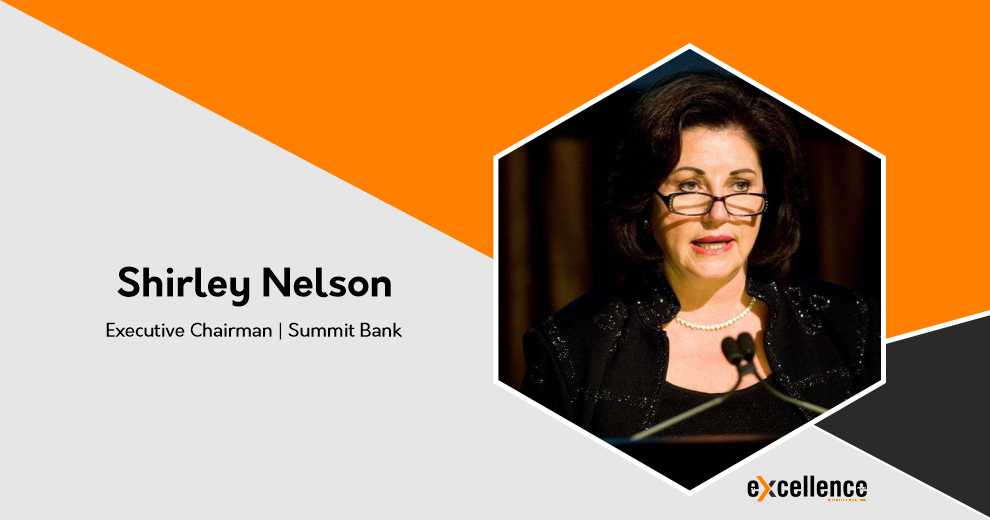
In an industry defined by numbers, regulations, and relentless competition, Shirley Nelson (Executive Chairman at Summit Bank) built her legacy around something far less measurable: trust.
For more than four decades, Shirley has shaped Summit Bank into one of California’s most respected independent community banks, not through aggressive expansion or flashy marketing campaigns, but through relationships, consistency, and an unwavering belief that banking should remain deeply personal. Her story is not simply one of corporate achievement. It is a story of persistence, resilience, and the determination to succeed in an industry that once told women leadership was not meant for them.
Long before titles and awards, the visionary leader was a young woman from a small town in Tennessee who never planned on a banking career. Life redirected her path after she moved to Alaska as a military spouse and young mother. A position as a teller at the National Bank of Alaska became the unexpected beginning of a lifelong journey into finance and leadership. What began as a job quickly evolved into a calling.
Building a Career in a World Built for Someone Else
When Shirley entered banking in the 1960s, leadership positions were overwhelmingly occupied by men. Advancement opportunities for women were limited, and recognition often came slowly, if at all. Yet she steadily climbed the ranks through discipline, instinct, and a remarkable ability to connect with people.
The resilient leader spent years managing branches and developing client relationships throughout the Bay Area. But despite her success, she encountered a reality familiar to many women of her generation: greater responsibility did not always come with equal opportunity or equal compensation.
One defining moment changed everything. After being offered expanded managerial responsibilities without a corresponding salary increase, Shirley recognized that the ceiling above her was unlikely to disappear on its own. Rather than accept the limitation, she chose to build something entirely new. That decision became the foundation of Summit Bank.
Launching a bank from the ground up was neither quick nor easy. It required years of preparation, regulatory approval, fundraising, and extraordinary persistence. Shirley entered unfamiliar territory without the networks or institutional support often available to established banking executives. Still, she moved forward with conviction. In 1982, Summit Bank officially opened its doors.
A Different Philosophy of Banking
From the beginning, Shirley envisioned Summit Bank as something fundamentally different from traditional financial institutions. The visionary leader understood that most banks offered similar products. What distinguished one institution from another was how clients were treated. That philosophy became the heart of Summit Bank’s identity.
Instead of operating through rigid transactional relationships, the bank focused on deeply personalized service. Employees were encouraged to know their clients personally, understand their ambitions, and approach banking with empathy rather than bureaucracy. This people-first culture proved especially powerful in lending decisions. While many institutions relied strictly on formulas and conventional risk models, Summit Bank often evaluated borrowers through a broader lens. Shirley believed character, work ethic, and future potential mattered just as much as spreadsheets.
That approach helped the bank build a strong reputation among medical professionals, entrepreneurs, and local businesses throughout California. It also reinforced something Shirley understood early in her career: relationships create loyalty in ways advertising never can. Remarkably, Summit Bank grew largely through referrals rather than large-scale marketing campaigns. Satisfied clients became ambassadors for the institution, introducing friends, colleagues, and families to the bank.
For the resilient leader, growth was never about becoming the largest bank in the region. It was about becoming one of the best.
Leadership Through Example
Those who have worked alongside Shirley frequently describe her leadership style as direct, disciplined, and deeply personal. She often describes herself simply as someone who “leads by example,” yet that understated description barely captures her influence. Her leadership philosophy rests on several enduring principles: accountability, curiosity, service, and consistency.
Curiosity, in particular, has remained central throughout her career. The visionary leader has repeatedly emphasized that asking questions was one of the greatest tools in her development as a banker and executive. From her earliest days as a teller to her role as Executive Chairman, she viewed learning as a lifelong responsibility. That mindset shaped Summit Bank’s internal culture.
Employees were encouraged to grow professionally, pursue training opportunities, and explore leadership paths within the organization. The bank invested heavily in employee development, including advanced banking education programs designed to cultivate future leaders. Equally important was Shirley’s commitment to opening doors for women in finance.
Having personally experienced gender inequality, she became determined to create leadership opportunities for others. Under her guidance, Summit Bank prioritized mentorship, advancement, and professional development for women throughout the company. Her career ultimately became proof that leadership is not granted by permission. It is earned through competence, resilience, and results.
Banking With a Sense of Responsibility
For Shirley, success has never been confined to financial performance alone. In 1998, the resilient leader founded the Summit Bank Foundation, extending the institution’s commitment to community service beyond traditional banking. The foundation focused heavily on education, healthcare, cancer research, and scholarships for underserved students throughout the Bay Area.
Over the years, the foundation partnered with prominent athletes and community leaders to create scholarship opportunities and support educational initiatives. It also funded medical research efforts, including clinical trials focused on lymphoma, breast cancer, leukemia, and multiple myeloma. This philanthropic work reflects Shirley’s broader philosophy about business leadership. She has long believed that institutions carry a responsibility to strengthen the communities they serve. Banking, in her view, is not merely transactional. It is relational and civic.
That perspective has become increasingly rare in modern finance, where scale and automation often overshadow personal connection. Yet Summit Bank’s longevity suggests there remains enduring value in Shirley’s approach.
Navigating Change Across Generations
After decades leading the organization, Shirley transitioned from day-to-day operational leadership into her role as Executive Chairman. Today, the visionary leader continues providing strategic guidance while watching a new generation carry the institution forward. One of the most meaningful aspects of this transition has been seeing her son, Steve Nelson, assume leadership responsibilities within the bank. She has openly spoken about her admiration for his authenticity and leadership capabilities, describing his growth as one of the most rewarding experiences of her career.
Yet even as leadership evolves, the institution’s foundational values remain unchanged. Summit Bank continues emphasizing personalized service, community engagement, and relationship-driven banking, principles established by Shirley more than forty years ago.
The Legacy of Endurance
Few executives remain relevant across multiple generations of economic change. Shirley has navigated recessions, regulatory shifts, technological transformation, and cultural change while maintaining the trust of clients and employees alike.
Her achievements extend beyond balance sheets and industry recognition. The resilient leader helped redefine what leadership could look like in community banking. She proved that empathy and profitability are not opposing forces. She demonstrated that resilience can outlast institutional bias. And she built an organization whose reputation rests not on marketing slogans, but on decades of earned credibility.
In many ways, Shirley represents a disappearing style of leadership, one grounded less in visibility and more in substance. At a time when industries move faster than ever, her story remains a reminder that trust still compounds more powerfully than ambition alone.